 TECH TIMES NEWS
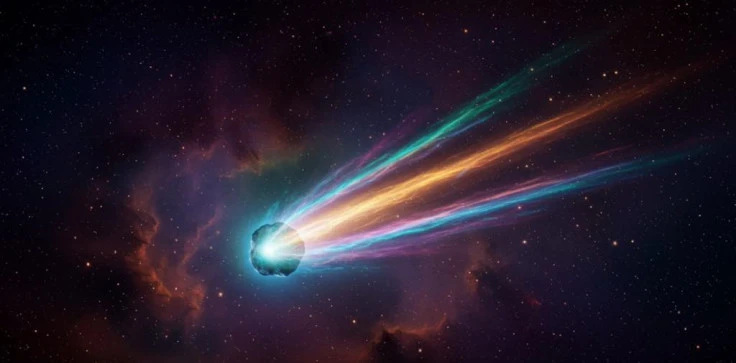
Astronomers have confirmed the detection of a new interstellar comet—an object that did not originate within our solar system but instead traveled across the vast distances between stars. These visitors are exceptionally rare; only a handful have ever been identified, making each detection a high-priority scientific event.
The comet was first spotted by wide-field survey telescopes designed to scan the sky for fast-moving objects. Its unusual speed and trajectory immediately set it apart, indicating that it was not gravitationally bound to the Sun. Instead, it is passing through on a one-time journey before returning to interstellar space.
What Makes It “Interstellar”?
Unlike typical comets that orbit the Sun, interstellar comets follow hyperbolic paths—meaning they are just passing through. This object’s velocity exceeds the solar system’s escape velocity, a clear signature of an origin beyond our stellar neighborhood.
Spectroscopic observations suggest that its chemical composition may differ from comets formed around our Sun. Early data hints at unusual ratios of volatile compounds such as carbon monoxide, water ice, and complex organic molecules. These differences could reflect the conditions of the distant star system where the comet formed.
Building on Past Discoveries
This discovery follows two landmark detections:
- ‘Oumuamua (2017): The first known interstellar object, notable for its unusual shape and lack of a visible coma.
- Comet Borisov (2019): A more conventional comet, rich in gas and dust, offering the first clear chemical analysis of an extrasolar body.
The newly detected comet appears to share characteristics with both—combining a visible coma with unusual motion and composition. This hybrid profile is already prompting fresh debates among astronomers.
Why Scientists Are Excited
Interstellar comets are essentially time capsules from other star systems. They preserve material from the early stages of planetary formation, untouched by our Sun’s environment.
By studying this object, researchers hope to:
- Compare chemical signatures across different star systems
- Understand how common certain molecules are in the galaxy
- Refine models of how planets and comets form beyond our solar system
Advanced observatories, including space-based telescopes, are being directed toward the comet to gather as much data as possible before it fades from view.
A Narrow Window for Observation
The opportunity to study this comet is limited. Because of its high speed, it will spend only a short time within range of detailed observation. Astronomers worldwide are coordinating efforts to track its path, measure its brightness, and analyze its composition.
Ground-based telescopes are working alongside instruments in orbit to capture data across multiple wavelengths—from visible light to infrared. Each dataset adds another piece to the puzzle of its origin.
Implications for Planetary Science
The presence of interstellar objects passing through our solar system suggests that planetary systems routinely eject debris into space. Over billions of years, these fragments drift between stars, occasionally entering other systems like ours.
This raises intriguing possibilities: the building blocks of planets—and potentially even the precursors to life—may be more widely shared across the galaxy than previously thought. While no direct link to life has been established, the chemical richness of such objects continues to fuel scientific curiosity.
The Bigger Picture
This latest interstellar visitor reinforces a growing realization: our solar system is not isolated. Instead, it exists within a dynamic galactic environment where material is constantly exchanged, albeit rarely observed.
Each new detection improves our ability to identify and study these objects earlier and in greater detail. Future surveys and more sensitive telescopes are expected to uncover many more such visitors, turning rare घटनाओं into a more routine area of study.
Conclusion: A Messenger from Afar
The newly discovered interstellar comet is more than just a fleeting celestial object—it is a messenger carrying clues from another star system. As scientists continue to analyze its properties, it promises to deepen our understanding of the universe’s diversity and the processes that shape planetary systems.