
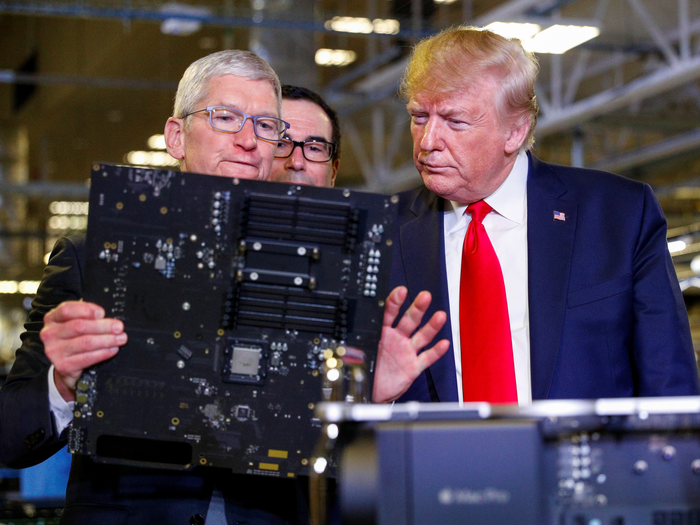
In a high-profile meeting, Apple CEO Tim Cook recently sat down with former U.S. President Donald Trump to discuss Apple’s plans for expanding its manufacturing and research operations in the United States. Following the discussion, Apple made a landmark announcement, committing to a $500 billion investment over the next four years to boost domestic production, innovation, and job creation.
Key Takeaways from the Meeting
1. Expanding U.S. Manufacturing and Job Creation
Apple’s new investment strategy includes:
- A new manufacturing facility in Houston, Texas, set to open in 2026, focused on assembling servers for Apple’s artificial intelligence (AI) systems.
- Creating approximately 20,000 new jobs across various sectors, including AI research, chip manufacturing, and product assembly.
- Doubling Apple’s Advanced Manufacturing Fund to $10 billion to support American suppliers and promote cutting-edge technology.
This aligns with the U.S. government’s broader push to reduce dependence on foreign production and strengthen domestic manufacturing, particularly in the wake of global supply chain challenges.
2. Navigating U.S.-China Trade Tensions
Apple’s decision to increase domestic manufacturing is also seen as a response to potential tariff hikes on Chinese imports. By producing more components in the U.S., Apple aims to safeguard its supply chain and avoid additional trade restrictions that could impact product pricing and availability.
Analysts believe that Tim Cook is strategically positioning Apple to mitigate risks associated with geopolitical uncertainties, ensuring business continuity and cost efficiency.
3. A Strategic Win for Both Apple and Trump
Apple’s move is being viewed as a win-win for both Tim Cook and Donald Trump:
- For Apple, this massive investment reinforces its commitment to the U.S. economy while securing government support for future policies favorable to tech companies.
- For Trump, this announcement strengthens his pro-manufacturing and job creation agenda, giving him a talking point in economic and political discussions.
Market and Industry Reactions
Despite the large investment, Apple’s stock dipped slightly by 0.6%, indicating a mixed reaction from investors. Some analysts view this as a bold, necessary step to sustain long-term growth, while others caution about rising operational costs and uncertain returns on large-scale domestic manufacturing.
Meanwhile, industry experts welcome Apple’s commitment to U.S. innovation, emphasizing that it sets a precedent for other tech giants to invest more in local production and research.
What’s Next?
Apple’s expansion plan marks a significant shift in its manufacturing strategy. The company will likely provide further updates on project timelines and job allocation in the coming months. Whether this move strengthens Apple's dominance in the tech industry or poses unforeseen challenges remains to be seen, but it is undoubtedly a game-changer for both Apple and the U.S. economy.