
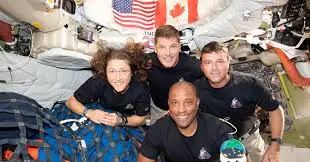
NASA’s Artemis II mission has reached one of its most crucial milestones, as the crew prepares to spend their final full day in space before initiating re-entry procedures toward Earth. This phase is not merely a countdown—it is a carefully orchestrated sequence of technical checks, trajectory adjustments, and crew readiness protocols designed to ensure a safe return from deep space.
Artemis II, the first crewed mission under NASA’s Artemis program, is aimed at validating the Orion spacecraft’s life-support systems, navigation capabilities, and overall performance in a real deep-space environment. Unlike low Earth orbit missions, this return involves significantly higher speeds and thermal stress, making preparation essential.
What Happens During the Final 24 Hours
The last full day in space is operationally dense. Astronauts and mission control work in tight coordination to execute a series of pre-re-entry tasks:
- System Diagnostics: Comprehensive checks of Orion’s avionics, propulsion, and life-support systems
- Trajectory Corrections: Fine-tuning the spacecraft’s re-entry angle to avoid skipping off the atmosphere or excessive heating
- Cabin Securing Procedures: Stowing equipment and configuring the spacecraft for high-G re-entry conditions
- Communication Tests: Ensuring stable contact with Earth during critical mission phases
These activities are essential because even minor deviations in re-entry parameters can significantly impact safety outcomes.
The Science and Risk Behind Re-Entry
Re-entering Earth’s atmosphere from deep space is fundamentally different from returning from the International Space Station. Artemis II’s Orion capsule is expected to hit atmospheric entry speeds of around 40,000 km/h, generating extreme heat due to atmospheric friction.
NASA’s advanced heat shield—one of the largest ever built for human spaceflight—plays a central role. It is designed to withstand temperatures approaching 2,800°C, protecting both the crew and onboard systems.
Experts emphasize that the “re-entry corridor” is extremely narrow. Enter too steeply, and the spacecraft risks structural overload; too shallow, and it could bounce back into space.
Human Factors: Preparing the Crew
Beyond engineering, the human element is equally critical. Astronauts undergo both physical and cognitive preparation for re-entry:
- G-Force Conditioning: Re-entry subjects astronauts to forces several times Earth’s gravity
- Mental Readiness: Precision timing and rapid response are required during final descent phases
- Emergency Protocol Review: Crew revisits contingency procedures in case of anomalies
This combination of human and machine readiness defines mission success in this final stretch.
Why Artemis II Matters for Future Lunar Missions
Artemis II is more than a standalone mission—it is a validation step for NASA’s broader lunar ambitions. The data gathered during re-entry will directly influence the design and execution of Artemis III, which aims to land astronauts on the Moon.
Key learnings include:
- Heat shield durability under real mission conditions
- Navigation accuracy in deep-space return trajectories
- Crew performance during high-stress mission phases
Each of these factors contributes to reducing risk in future long-duration lunar and eventually Mars missions.
Expert Insight: Precision Is Everything
Spaceflight analysts consistently highlight that re-entry is one of the most unforgiving phases of any mission. According to aerospace experts, Artemis II’s success will depend on “tight integration between onboard autonomy and ground-based guidance.”
The Orion spacecraft incorporates automated systems capable of making real-time adjustments, but mission control remains deeply involved, monitoring telemetry and guiding decision-making when necessary.
The Final Countdown to Splashdown
Once the final day concludes, Artemis II will initiate its re-entry burn, aligning the spacecraft for atmospheric descent. Following re-entry, Orion is expected to deploy parachutes and complete a controlled splashdown in the ocean, where recovery teams will retrieve the crew.
This moment will mark the successful completion of humanity’s first crewed deep-space mission in over five decades—reviving capabilities last demonstrated during the Apollo era.
Bottom Line
The Artemis II crew’s last full day in space is not just a procedural milestone—it is a defining test of modern human spaceflight systems. From precision navigation to thermal protection and human endurance, every element must perform flawlessly. As NASA moves closer to sustained lunar exploration, the success of this phase will shape the trajectory of space missions for years to come.