
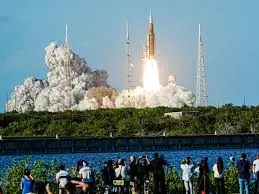
In a landmark achievement for global space exploration, NASA’s Artemis II mission has successfully carried astronauts into orbit, setting the stage for humanity’s long-awaited return to the Moon. This mission represents the first crewed lunar journey since Apollo 17 in 1972, signaling a new era of deep space exploration driven by international collaboration and advanced technology.
The Artemis II crew includes four astronauts—three from NASA and one from the Canadian Space Agency (CSA)—highlighting the mission’s global significance. Their journey is not just symbolic; it is a critical step toward establishing a sustainable human presence on the Moon.
Mission Profile: A Carefully Planned Lunar Flyby
Unlike the upcoming Artemis III mission, which aims to land astronauts on the lunar surface, Artemis II is designed as a crewed lunar flyby mission. The spacecraft will travel approximately 370,000 kilometers from Earth, looping around the Moon before returning home.
The mission uses NASA’s Space Launch System (SLS) rocket—the most powerful rocket ever built—paired with the Orion spacecraft, which is specifically engineered for deep-space human travel. Orion will sustain astronauts for a journey lasting roughly 10 days, testing life-support systems, navigation, and communication in real deep-space conditions.
Why This Mission Matters: Beyond Symbolism
Artemis II is not just a milestone—it’s a proving ground. NASA is validating critical systems that will support future lunar landings and, eventually, human missions to Mars.
Key objectives include:
- Testing deep-space life support systems
- Evaluating radiation exposure limits
- Demonstrating manual spacecraft control capabilities
- Validating re-entry and splashdown safety
Experts note that these systems must perform flawlessly in deep space, where real-time support from Earth is limited due to communication delays.
Technology and Engineering: Built for the Next Era
The mission showcases cutting-edge engineering. The SLS rocket generates over 8.8 million pounds of thrust, surpassing even the Saturn V. Meanwhile, Orion features advanced heat shields capable of withstanding temperatures near 2,800°C during re-entry.
Additionally, the spacecraft integrates modern avionics, autonomous navigation, and improved safety systems—lessons learned from Artemis I, the uncrewed test flight completed in 2022.
Human Element: Astronauts at the Center
Beyond the technology, Artemis II is fundamentally a human story. The crew will become the first people in decades to view the far side of the Moon directly—a perspective only 24 humans in history have ever experienced.
Their role extends beyond piloting; they are active test operators, responsible for validating onboard systems and handling real-time contingencies. This hands-on involvement is essential for refining procedures for future lunar landings.
Global and Commercial Implications
Artemis II also reflects a shift in how space missions are conducted. NASA is working closely with international partners and private companies, including SpaceX, which is developing the lunar lander for Artemis III.
This collaborative model is expected to:
- Accelerate innovation
- Reduce mission costs over time
- Expand participation in space exploration
For countries like Canada, participation in Artemis II strengthens their role in future lunar infrastructure projects, including the planned Lunar Gateway space station.
What Comes Next: The Road to Artemis III
If Artemis II meets its objectives, the next mission—Artemis III—will aim to land astronauts near the Moon’s south pole, a region believed to contain water ice. This resource could be crucial for sustaining long-term human presence and producing fuel for deeper space missions.
NASA’s broader Artemis program ultimately aims to establish a sustainable lunar economy, paving the way for human missions to Mars in the 2030s.
Strategic Takeaway
Artemis II is more than a mission—it’s a systems test for humanity’s deep-space future. For readers, the key takeaway is clear: this is the transition point from experimental exploration to sustainable presence beyond Earth. The technologies, partnerships, and lessons from Artemis II will directly shape how—and how soon—humans step onto Mars.