
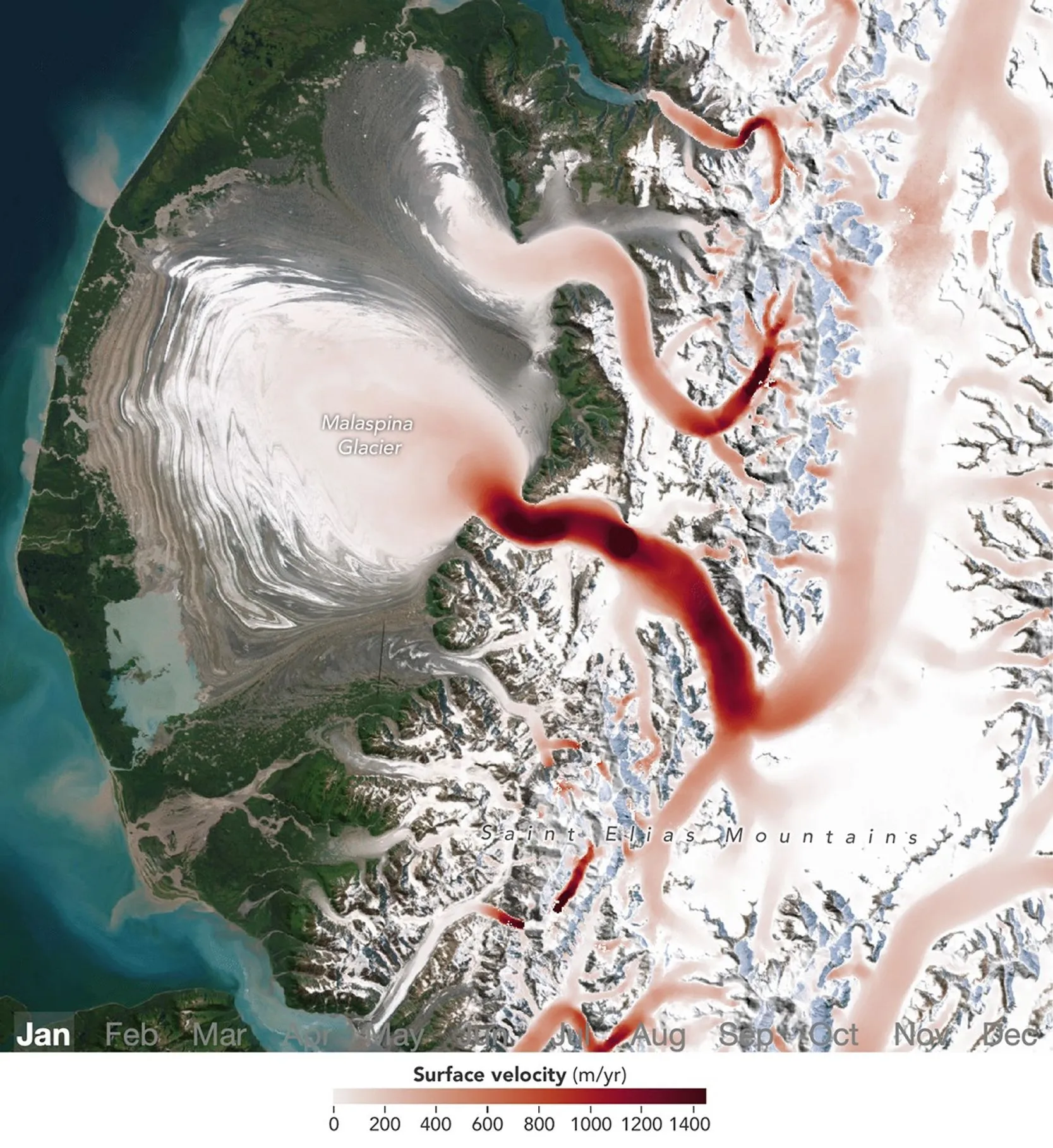
In a breakthrough for climate and cryosphere research, an international team of scientists has unveiled the first-ever global map showing how glaciers speed up during summer and significantly slow down in winter. The study, built on years of satellite observations, offers the most complete picture yet of how seasonal meltwater affects glacier motion across continents.
🛰️ High-Resolution Satellite Data Unlocks Seasonal Ice Flow Patterns
Using data from multiple Earth-observing satellites, researchers analyzed glacier motion across thousands of ice bodies in the Arctic, Antarctic, Himalayas, Andes, Alps, and Alaska. The new map captures monthly shifts in glacier speeds with unprecedented precision, providing scientists with a powerful tool to understand how warming temperatures influence ice movement.
🌞 Summer Meltwater Causes Glaciers to Surge
The study reveals a consistent pattern: as temperatures rise and meltwater drains beneath the ice, glaciers gain lubrication at their base and begin to slide faster. In regions like Greenland, Alaska, and the European Alps, summer speedups were especially pronounced, with some glaciers accelerating by as much as 20–50 percent.
❄️ Winter Brings a Dramatic Slowdown
During winter, when melting nearly stops, glaciers return to a slower, more stable pace. Reduced meltwater flow and refreezing conditions help the ice settle, decreasing movement dramatically. This seasonal slowdown, the researchers say, is crucial for understanding long-term glacier health and predicting how they will respond to continued warming.
🌎 Global Climate Patterns Drive Regional Differences
The new map reveals striking regional contrasts. While polar glaciers show large summer surges due to extensive surface melting, many high-elevation glaciers in the Himalayas and Karakoram display subtler shifts influenced by monsoon patterns and snowfall cycles. These regional differences underscore the importance of tracking glacier behavior in diverse climatic environments.
📉 Key Insight for Sea-Level Rise Predictions
Understanding seasonal glacier dynamics is essential for improving sea-level rise projections. Faster summer flow can push more ice into oceans, especially in marine-terminating glaciers. Scientists say the new dataset will significantly improve climate models and help countries prepare for future coastal risks.
💧 Implications for Freshwater Supply
Beyond sea-level concerns, these findings also affect countries reliant on glacier-fed rivers. As melting patterns shift, seasonal water flow for millions of people in Asia, South America, and parts of Europe could change dramatically. The study emphasizes the need for long-term monitoring of glacier-fed watersheds.
🔬 A New Era for Glacier Monitoring
Researchers believe this global map will open the door to more accurate forecasting of glacier evolution in a warming world. The dataset is expected to support future climate assessments, disaster planning, and environmental policy-making across multiple regions.