
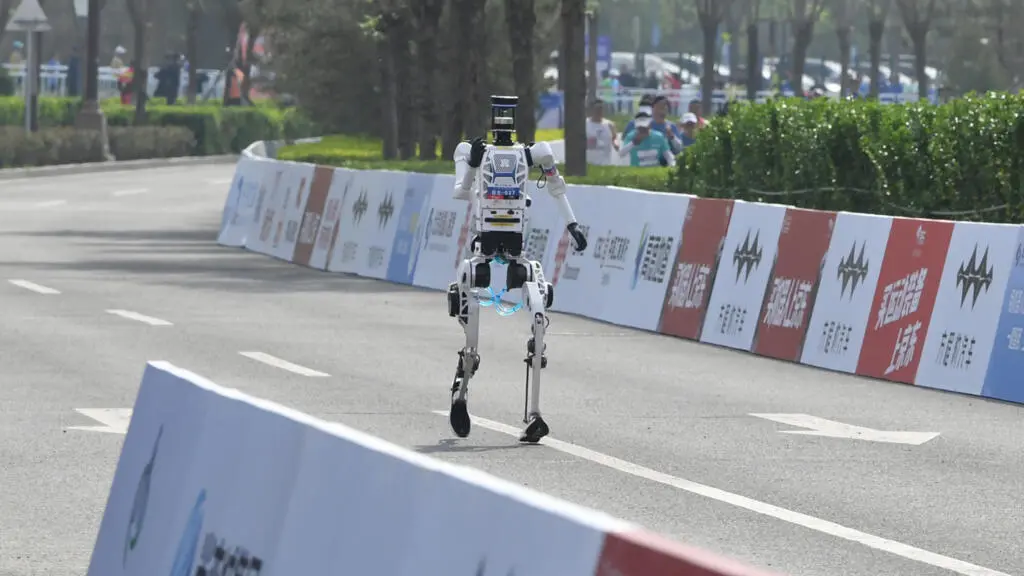
In a striking demonstration of how far robotics has evolved, humanoid robots participated in a Beijing half-marathon and managed to outperform segments of human runners. While not all machines completed the course independently, the event marked a significant milestone: robots are no longer confined to controlled lab environments—they are now capable of sustained, real-world physical performance.
The race, held in Beijing in April 2026, featured multiple research teams and robotics companies showcasing bipedal machines designed to mimic human gait, balance, and endurance. Though the robots competed under varied conditions—some assisted, others fully autonomous—the overall performance highlighted rapid progress in “embodied AI,” where intelligence is integrated with physical capability.
What Made These Robots Competitive?
At the core of this achievement lies a convergence of hardware and software innovation. Modern humanoid robots are equipped with high-torque electric actuators, lightweight composite frames, and advanced battery systems that allow for longer operational cycles.
Equally critical is the software stack. These machines rely on real-time motion planning, reinforcement learning, and sensor fusion—combining inputs from LiDAR, cameras, and inertial measurement units—to maintain balance and adapt to changing terrain. Unlike earlier prototypes that struggled with stability, today’s robots can dynamically adjust stride and posture, even under fatigue conditions.
Experts note that endurance, not just speed, is the key breakthrough here. Completing long-distance runs requires energy optimization, thermal management, and consistent gait control—areas where robots have historically lagged behind humans.
China’s Strategic Push in Robotics
The event also reflects China’s broader ambition to lead in advanced robotics and AI. Over the past decade, the country has heavily invested in automation, not just for manufacturing but for service sectors, logistics, and urban infrastructure.
State-backed initiatives and private-sector innovation have accelerated the development of humanoid platforms capable of operating in human-centric environments. By showcasing robots in a public, high-visibility event like a half-marathon, China is signaling confidence in the maturity of its robotics ecosystem.
Reality Check: Not Yet a Human Replacement
Despite the impressive प्रदर्शन, it’s important to separate spectacle from practical reality. The robots did not uniformly “beat” elite human athletes in a strict competitive sense. Many relied on predefined routes, external monitoring, or limited autonomy in certain phases of the race.
Moreover, energy efficiency remains a major constraint. Humans still far outperform robots in terms of metabolic efficiency and adaptability. A trained runner can complete a half-marathon with far less ऊर्जा expenditure than even the most advanced humanoid robot today.
Why This Matters Beyond the Race
The real takeaway isn’t about robots replacing marathon runners—it’s about capability transfer. The same technologies enabling robots to run long distances can be applied to warehouses, disaster response, elder care, and field operations.
For instance, improved balance and mobility mean robots can navigate uneven terrain in search-and-rescue missions. Enhanced endurance translates to longer operational hours in logistics or security roles. In healthcare, humanoid robots could assist patients with mobility challenges.
The Road Ahead for Humanoid Robotics
Looking forward, the next phase of development will likely focus on autonomy, efficiency, and cost reduction. Fully autonomous navigation in unpredictable environments remains a key challenge. At the same time, making these systems economically viable will determine how quickly they move from demonstrations to widespread adoption.
Industry analysts expect that within the next decade, humanoid robots will become increasingly common in semi-structured environments, working alongside humans rather than replacing them outright.
Conclusion: A Glimpse Into a Hybrid Future
The Beijing half-marathon may not redefine athletics, but it does redefine expectations from machines. Humanoid robots running alongside—and in some cases ahead of—humans is less about competition and more about convergence.