
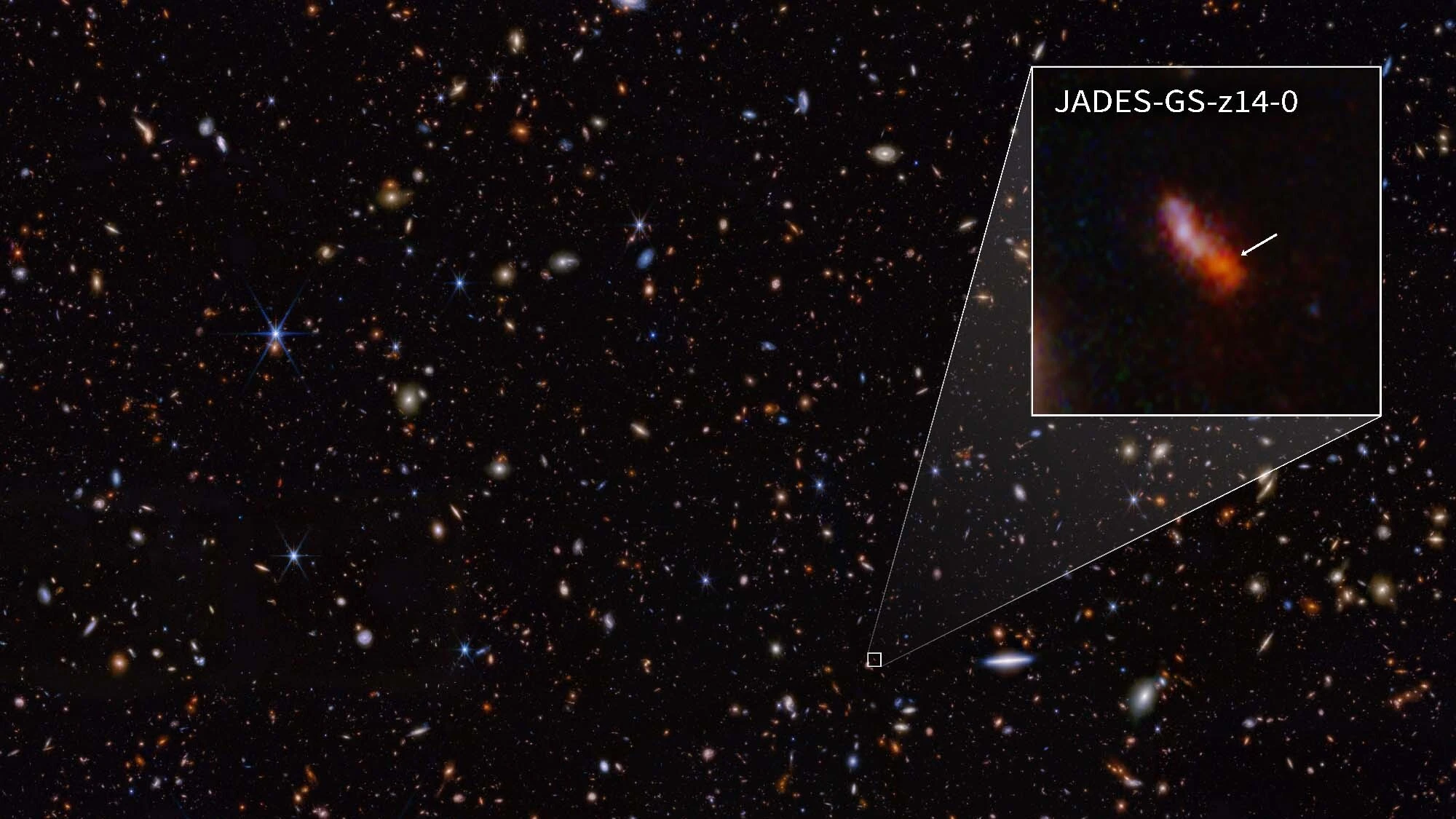
Astronomers using NASA’s James Webb Space Telescope (JWST) have identified a population of galaxies that appear to have formed remarkably early in cosmic history—within a few hundred million years after the Big Bang. These findings are reshaping scientific understanding of how quickly the first galaxies assembled and evolved in the young universe.
The newly observed galaxies date back to a period when the universe was less than 5% of its current age. Scientists were surprised not only by their age but also by their apparent size, structure, and stellar mass, which suggest that galaxy formation began far earlier and progressed more rapidly than previously thought.
A Window into the Cosmic Dawn
The discoveries were made possible by JWST’s advanced infrared instruments, which allow it to peer through vast stretches of space and time. Because light from distant galaxies takes billions of years to reach Earth, Webb effectively acts as a time machine, capturing images of galaxies as they existed over 13 billion years ago.
Several of the detected galaxies show characteristics of evolved systems—containing mature stars and complex structures. This challenges earlier models that predicted early galaxies would be small, irregular, and slowly growing. Instead, some of these systems appear surprisingly developed for such an early epoch.
Rewriting Theories of Galaxy Formation
Prior to JWST’s launch, data from the Hubble Space Telescope suggested that galaxies formed gradually over hundreds of millions of years. However, Webb’s sharper resolution and deeper infrared sensitivity are revealing that massive galaxies may have emerged much sooner.
Researchers are now examining whether current cosmological models need adjustment. Some scientists suggest that star formation in the early universe may have been more efficient than assumed. Others are exploring whether dark matter halos—the gravitational scaffolding of galaxies—formed and accumulated matter more rapidly.
Implications for Understanding the Early Universe
These findings have significant implications for the study of cosmic reionization—the period when the first stars and galaxies ionized the surrounding hydrogen gas, making the universe transparent to light. The presence of mature galaxies during this era indicates they may have played a major role in shaping the universe’s evolution.
Additionally, the data could offer clues about the formation of supermassive black holes, as some early galaxies appear massive enough to host them.
More Discoveries Expected
Scientists emphasize that these results are only the beginning. As JWST continues deep-field observations and spectroscopic analysis, researchers expect to refine distance measurements and better determine the chemical composition of these ancient galaxies.