
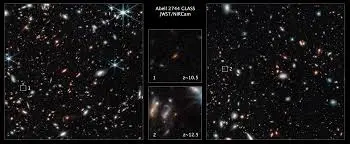
NASA’s James Webb Space Telescope (JWST) has once again peered deep into the early universe, uncovering extraordinary details about the first galaxies that formed after the Big Bang. Using its advanced infrared instruments, Webb has observed galaxies that existed over 13 billion years ago, revealing chaotic, fast-paced processes that shaped the universe’s earliest structures.
Revealing the First Generation of Galaxies
The observations, published by an international team of astronomers, indicate that the first galaxies were far from the serene, spiral structures we see today. Instead, they were compact, clumpy, and turbulent — forming stars at astonishing rates. These findings challenge long-standing theories suggesting that early galaxies were relatively calm and evolved gradually.
Violent Star Formation and Cosmic Collisions
Data collected by Webb’s NIRCam (Near-Infrared Camera) and NIRSpec (Near-Infrared Spectrograph) instruments show that early galaxies were sites of intense starburst activity, producing new stars up to ten times faster than typical modern galaxies. Astronomers also detected evidence of frequent galactic mergers, where smaller protogalaxies collided and coalesced — fueling rapid growth and energy release.
Chemical Clues From the Early Universe
Spectroscopic analysis revealed the presence of heavy elements such as oxygen and carbon, indicating that even within a few hundred million years after the Big Bang, the first generations of massive stars had already lived and died, enriching their surroundings. This rapid chemical evolution suggests the universe matured faster than previously believed.
Rethinking Cosmic Evolution Models
These findings compel scientists to rethink models of galaxy formation, especially how quickly matter condensed and stars ignited in the early epochs. Dr. Sarah Johnson, an astrophysicist involved in the study, noted, “We’re seeing the building blocks of modern galaxies come together in ways more violent and dynamic than our simulations ever predicted.”
Looking Ahead: Mapping the Universe’s Origins
With JWST continuing to push the boundaries of cosmic observation, astronomers hope to map the transition from the cosmic dark ages to the era of light, when the first galaxies illuminated the universe. Future observations will delve deeper into how black holes, gas clouds, and stellar winds shaped the earliest galaxies.