
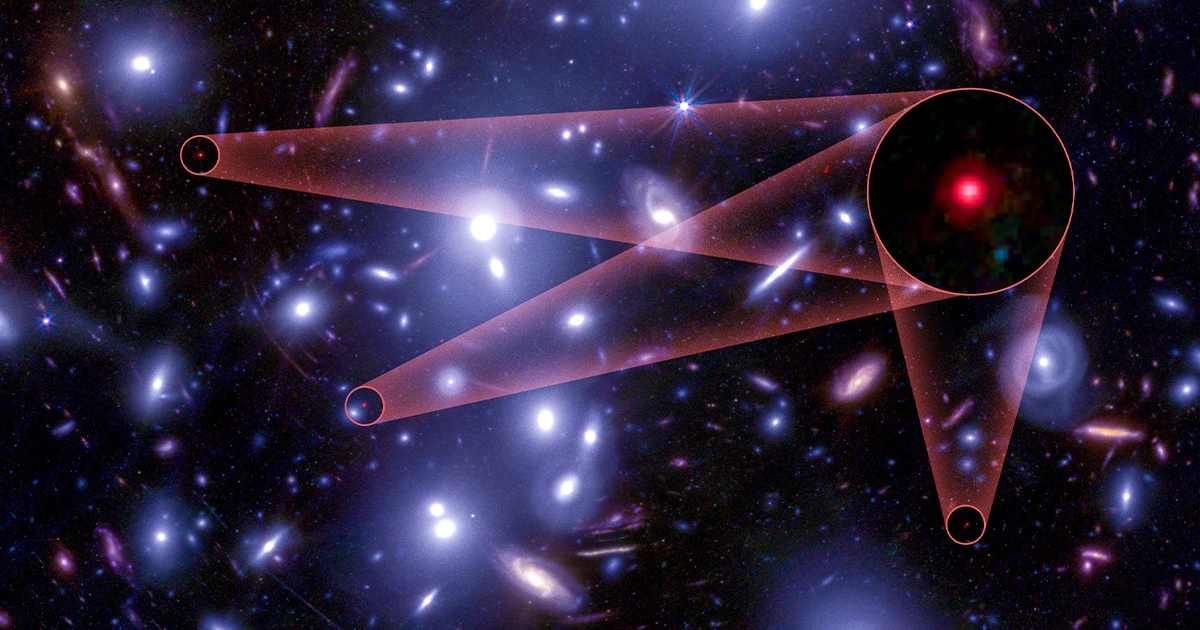
Astronomers have taken a major step toward solving one of cosmology’s biggest puzzles: how supermassive black holes formed so quickly after the Big Bang. New observations from the James Webb Space Telescope (JWST) are offering unprecedented insights into the early universe, revealing how massive black holes may have emerged within the first billion years of cosmic history.
For decades, scientists struggled to explain how black holes weighing millions to billions of times the mass of the Sun could exist when the universe itself was still in its infancy. JWST’s deep infrared vision is now providing clues that earlier telescopes simply could not detect.
Direct Collapse May Be the Missing Link
Data from JWST suggests that some of the earliest supermassive black holes may not have grown slowly from stellar remnants, as once thought. Instead, they may have formed through a “direct collapse” process, where enormous clouds of pristine gas collapsed rapidly under gravity, bypassing the star-formation stage altogether.
This mechanism allows black holes to reach massive sizes far more quickly than traditional growth models, helping explain why such colossal objects appear so early in the universe.
Peering Into Ancient Galaxies
JWST has identified surprisingly mature galaxies dating back more than 13 billion years. Many of these galaxies show strong signatures of active black holes at their centers, including intense radiation patterns that indicate rapid accretion of matter.
These findings suggest that black holes and galaxies may have evolved together from the very beginning, reshaping theories about galaxy formation and cosmic structure.
Chemical Fingerprints of the Early Cosmos
Using advanced spectroscopy, JWST detected distinct chemical signatures in early galaxies that point to environments rich in hydrogen and helium but low in heavier elements. Such conditions are ideal for direct-collapse black hole formation, strengthening the case that this process played a crucial role in the early universe.
These chemical fingerprints also help astronomers map how the first cosmic structures influenced the evolution of matter across billions of years.
Redefining Black Hole Evolution Models
The discovery is prompting scientists to revise long-standing models of black hole growth. Instead of gradual evolution alone, early supermassive black holes may have formed through multiple pathways, combining rapid collapse with later mergers and sustained feeding.
Researchers say JWST’s findings will guide future simulations and observations, bringing astronomers closer to a unified theory of black hole origins.
What Comes Next
As JWST continues its mission, astronomers plan deeper surveys targeting even earlier epochs of the universe. Each new dataset is expected to refine our understanding of how the first black holes shaped galaxies, stars, and ultimately the cosmic landscape we observe today.