
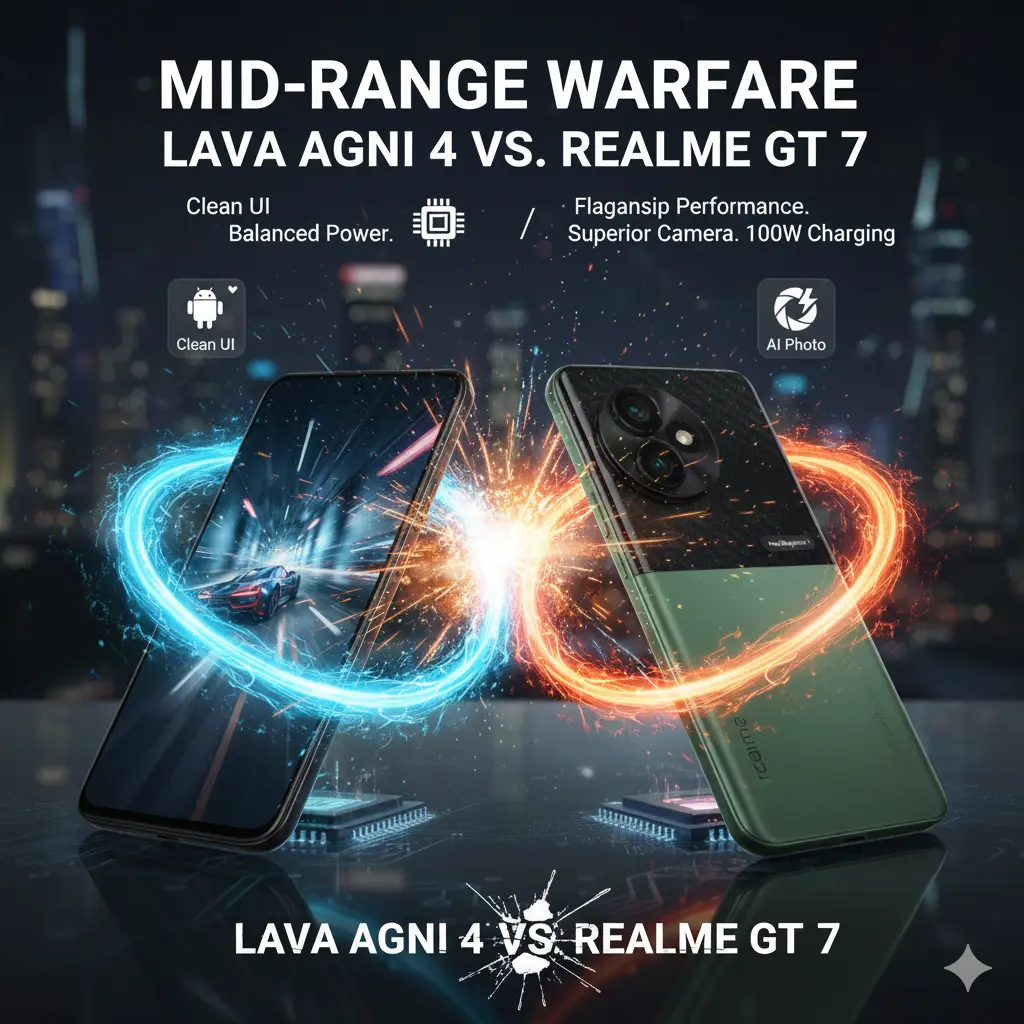
India’s mid-range smartphone market has become fiercely competitive, and the latest showdown features the newly launched Lava Agni 4 facing Realme’s performance-focused GT 7. Both phones target users who want flagship-grade features without crossing premium price brackets. While Lava continues its push as a homegrown challenger, Realme is doubling down on performance hardware and camera upgrades.
Design Focus: Sleek Curves vs Performance Appeal
The Lava Agni 4 embraces a refined matte-glass finish with a slim profile, aiming at users who prefer a clean, understated aesthetic. In contrast, the Realme GT 7 leans into a sportier look with a dual-tone back and more prominent camera deco.
Both phones include in-display fingerprint sensors and flat-edge frames, but Realme’s polish and ergonomics give it a slight upper hand.
Display: 144Hz Smoothness vs Flagship-Level Brightness
Lava equips the Agni 4 with a 6.78-inch FHD+ AMOLED panel, supporting up to 144Hz refresh rate. The display is tuned for gamers and users who value responsiveness.
The Realme GT 7 counters with a 6.74-inch 1.5K AMOLED display boasting higher peak brightness and better HDR calibration. While Lava wins the numbers game in refresh rate, Realme’s screen offers richer contrast and superior outdoor visibility.
Performance Battle: Dimensity Punch or Snapdragon Speed?
Under the hood, the Lava Agni 4 features the MediaTek Dimensity 8300 Ultra, a strong mid-range chipset focusing on thermal stability and efficient multitasking.
Realme GT 7 opts for Qualcomm’s Snapdragon 8s Gen 3, which brings near-flagship performance, especially in GPU-intensive tasks.
Benchmark trends show:
-
Realme GT 7 leads in gaming and AI tasks
-
Agni 4 delivers cooler sustained performance and better efficiency
Camera Capabilities: Homegrown Tuning vs Flagship Algorithms
Lava uses a 50MP main sensor with OIS, paired with an 8MP ultrawide shooter. The focus is on natural color science and sharp daytime photography.
Realme GT 7 takes the advantage with a 50MP Sony sensor, also stabilized (OIS), supported by enhanced computational photography, improved low-light algorithms, and AI portrait modes.
In night shots and video stabilization, Realme clearly leads.
Battery & Charging: A Close Competition
Both phones offer 5,000mAh batteries, but charging speeds differ:
-
Lava Agni 4: 68W fast charging
-
Realme GT 7: 100W SuperVOOC fast charging
Realme refuels significantly faster, with a full charge in under 30 minutes.
Software Experience: Clean UI vs Feature-Rich Realme UI
Lava’s custom UI is close to stock Android with minimal bloat — a plus for users seeking simplicity.
Realme UI 6 brings more customization, AI enhancements, and improved background optimization, but also includes additional apps that some users may consider clutter.
Pricing & Availability: Value vs Performance
Early pricing suggests:
-
Lava Agni 4: Expected around ₹24,999–₹26,999
-
Realme GT 7: Expected around ₹29,999–₹31,999
Lava’s value positioning may appeal to budget-focused users, while Realme offers stronger all-round performance for a slightly higher price.
Final Verdict: Which One Should You Choose?
-
Choose Lava Agni 4 if you prefer:
✔ Clean software experience
✔ Excellent refresh rate
✔ Balanced performance at a lower price -
Choose Realme GT 7 if you prefer:
✔ Best-in-segment performance
✔ Superior display and camera quality
✔ Faster charging and a more premium experience
Both phones bring serious upgrades to the mid-range category, but the Realme GT 7 edges ahead for power users, while Lava Agni 4 shines as a value-driven alternative.