
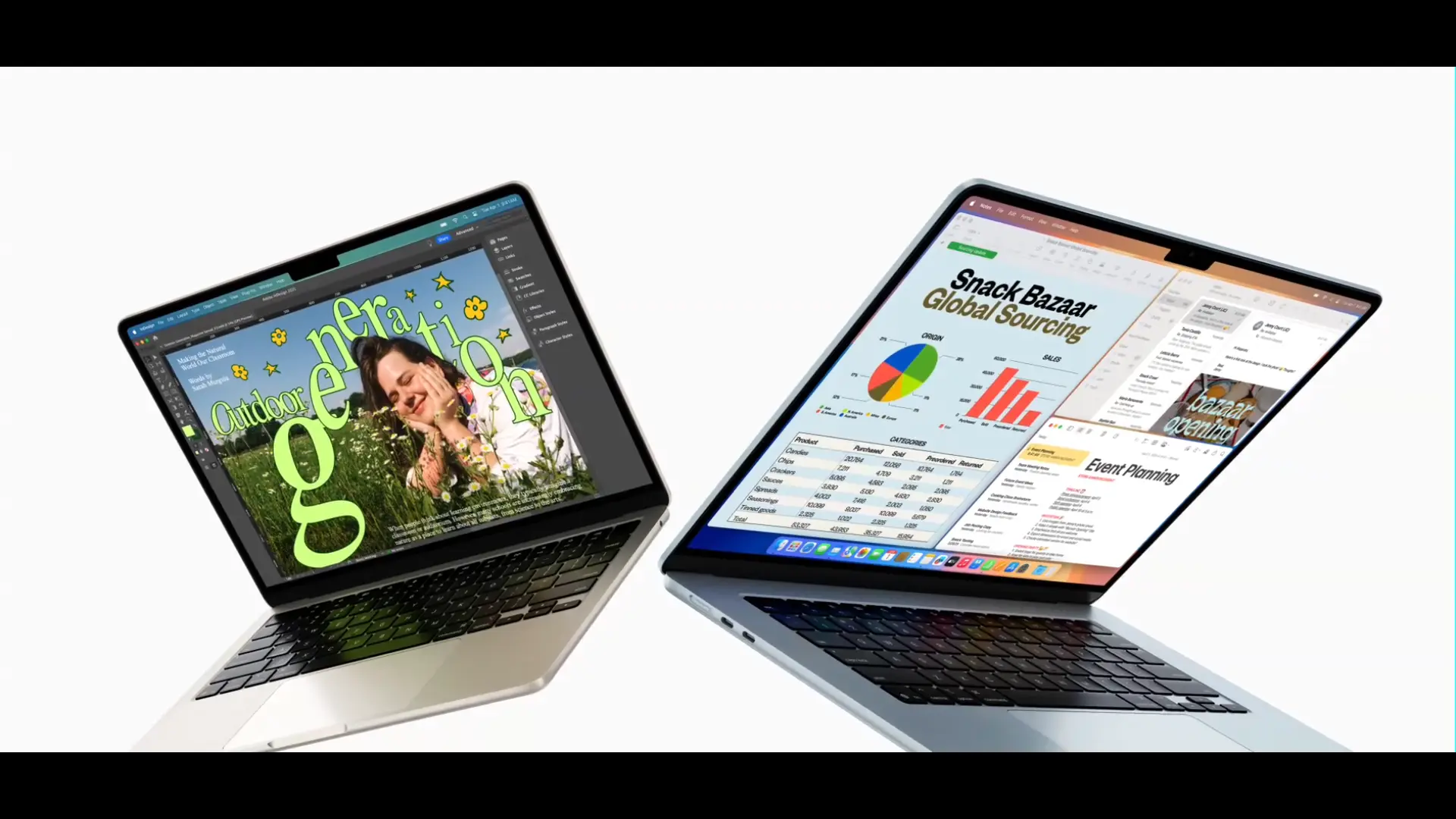
Apple is gearing up to introduce the highly anticipated MacBook Air M4, succeeding the current M3-powered model. As with every generational leap, the new MacBook Air is expected to bring notable advancements in performance, efficiency, and overall user experience. Here are the five biggest changes coming with the M4 MacBook Air compared to its predecessor, along with expected specifications.
1. Next-Generation M4 Chip
The most significant upgrade in the new MacBook Air will be Apple’s latest M4 chip. Built on an improved fabrication process, the M4 chip is expected to deliver enhanced CPU and GPU performance while being more power-efficient. Apple is rumored to be pushing AI-focused enhancements with the M4, making macOS AI-driven tasks smoother and more responsive. Users can anticipate faster multitasking, improved gaming capabilities, and even better video editing performance compared to the M3 chip.
2. More Efficient Battery Life
Apple’s MacBooks are already known for their industry-leading battery efficiency, but the M4 chip is likely to push this even further. Thanks to an optimized architecture and improved energy management, the MacBook Air M4 may offer an extra hour or two of battery life compared to the M3 variant. This could translate to more real-world usage time, making the Air an even more compelling choice for students, professionals, and travelers.
3. Better Display with Higher Brightness
The MacBook Air M4 is expected to come with a refined Liquid Retina display that boasts improved brightness and color accuracy. While the M3 MacBook Air already offers a stunning display, the new model may feature a peak brightness upgrade, potentially reaching up to 600 nits or more. This change would make the MacBook Air M4 even better for outdoor usage and HDR content consumption.
4. Wi-Fi 7 Support for Faster Connectivity
Another key upgrade with the M4 MacBook Air is the inclusion of Wi-Fi 7 support. The M3 model comes with Wi-Fi 6E, but the next-gen version is expected to deliver significantly faster wireless speeds, lower latency, and improved connection stability. This will be particularly beneficial for professionals working with cloud-based applications, gamers, and those who rely on ultra-fast internet speeds for streaming or large file transfers.
5. Potential Design Refinements
While Apple is unlikely to make drastic changes to the MacBook Air’s thin and lightweight design, subtle refinements could be introduced. These might include a slightly more compact form factor, improved speaker technology, and minor tweaks to enhance durability. Additionally, rumors suggest Apple could expand its color palette, offering new finishes to differentiate the M4 MacBook Air from its predecessors.
Expected Specifications Comparison
| Feature | MacBook Air M3 | MacBook Air M4 (Expected) |
|---|---|---|
| Chip | Apple M3 | Apple M4 |
| CPU Cores | 8-core | 8-core (improved) |
| GPU Cores | Up to 10-core | Up to 12-core |
| RAM | 8GB/16GB/24GB | 8GB/16GB/32GB |
| Storage | 256GB-2TB SSD | 256GB-2TB SSD |
| Display | 13.6" Liquid Retina, 500 nits | 13.6"/15.3" Liquid Retina, 600 nits (expected) |
| Battery Life | Up to 18 hours | Up to 20 hours (expected) |
| Wi-Fi | Wi-Fi 6E | Wi-Fi 7 |
| Ports | 2x USB-C, MagSafe 3, Headphone Jack | Same as M3 |
| Weight | ~2.7 lbs (13") / 3.3 lbs (15") | ~2.7 lbs (13") / 3.3 lbs (15") |
| Colors | Midnight, Starlight, Silver, Space Gray | Potential new finishes |
Final Thoughts
The MacBook Air M4 is shaping up to be an impressive successor to the M3 model, offering meaningful performance upgrades, better battery life, and next-generation connectivity. While Apple has yet to confirm an official release date, industry experts predict a mid-to-late 2025 launch. As Apple continues its push toward AI integration and power efficiency, the MacBook Air remains one of the most attractive ultraportable laptops on the market.