
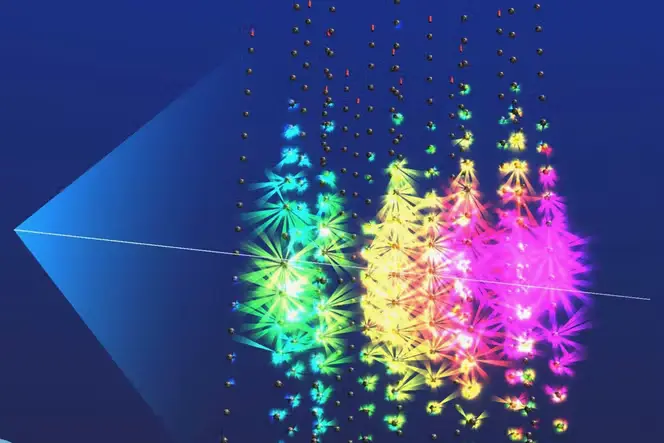
Scientists have reported the detection of an ultra-high-energy neutrino originating from deep beneath the Mediterranean Sea, marking one of the most powerful neutrino signals ever recorded. The event was captured by a network of underwater sensors designed to observe elusive subatomic particles that rarely interact with matter.
Neutrinos are often called “ghost particles” because they can pass through entire planets without leaving a trace. Detecting one—especially at such extreme energy levels—is both rare and scientifically valuable.
What Makes This Detection Extraordinary
What sets this discovery apart is the sheer energy of the detected neutrino. Early analyses suggest that its energy far exceeds that of typical neutrinos produced by the Sun or nuclear reactions, placing it in the category of ultra-high-energy cosmic neutrinos.
These particles are believed to originate from the most violent environments in the universe, such as:
- Supermassive black holes
- Gamma-ray bursts
- Colliding neutron stars
- Active galactic nuclei
However, the exact source of this neutrino remains unknown, making the detection even more intriguing.
How Scientists Detected It
The neutrino was detected by an advanced deep-sea observatory, likely part of the KM3NeT (Cubic Kilometre Neutrino Telescope) project. Located on the seabed of the Mediterranean, this facility uses thousands of حساس light sensors to capture faint flashes produced when neutrinos interact with water molecules.
Why underwater detection matters:
- Water acts as a natural shield against background noise
- Large detection volumes increase chances of rare interactions
- Deep-sea environments provide stable observation conditions
This setup allows scientists to monitor vast regions of space indirectly by observing particles that reach Earth.
Why the Origin Remains a Mystery
Despite the precision of modern detectors, tracing a neutrino back to its exact source is extremely challenging. Unlike charged particles, neutrinos travel in straight lines, but their weak interactions make them difficult to study in detail.
In this case, the neutrino’s trajectory does not clearly point to any known high-energy astrophysical object. This raises several possibilities:
- The source could be a previously undetected cosmic phenomenon
- It may originate from a distant or obscured region of space
- Current models of particle acceleration may be incomplete
Implications for Astrophysics and Particle Physics
This discovery could have far-reaching consequences for both astrophysics and fundamental physics.
Key implications include:
- New cosmic accelerators: Evidence of unknown sources capable of producing extreme energies
- Model revisions: Existing theories on high-energy particle formation may need refinement
- Neutrino astronomy growth: Strengthens the role of neutrinos as tools to study the universe
Experts suggest that such detections can complement traditional observations made using light, radio waves, or gravitational waves.
The Growing Role of Neutrino Observatories
The detection underscores the importance of next-generation neutrino observatories like KM3NeT and IceCube in Antarctica. These facilities are expanding humanity’s ability to observe the universe beyond conventional methods.
As more detectors come online and data collection improves, scientists expect:
- Better source identification
- Higher detection rates of rare events
- Deeper insights into cosmic phenomena
What Comes Next
Researchers are now analyzing the data in detail and comparing it with observations from other telescopes worldwide. Collaborative efforts may help pinpoint the origin or at least narrow down possible sources.
Future detections of similar high-energy neutrinos will be crucial in confirming whether this event is an outlier—or part of a larger, unexplored cosmic pattern.
Bottom Line
The detection of an ultra-high-energy neutrino beneath the Mediterranean Sea is more than just a rare scientific event—it’s a potential clue to some of the universe’s most powerful and mysterious processes. While its origin remains uncertain, the discovery pushes the boundaries of current knowledge and sets the stage for deeper exploration into the high-energy universe.