
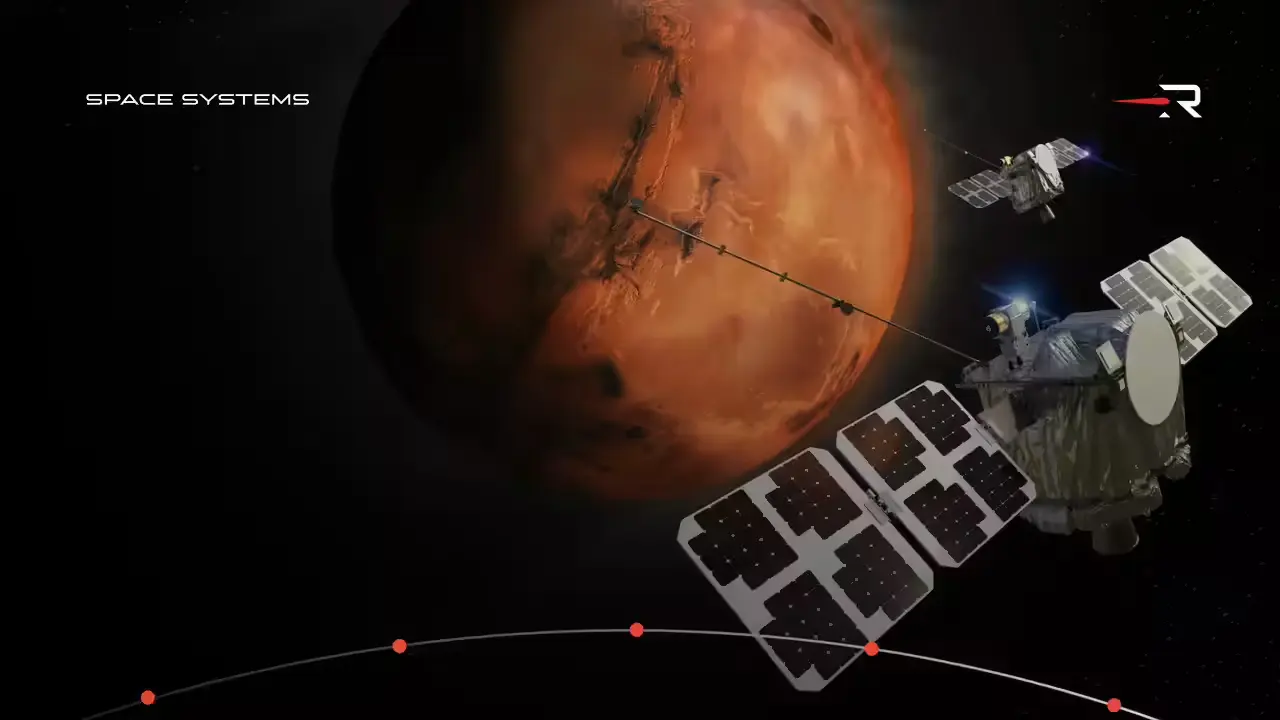
NASA is preparing to launch its ESCAPADE mission (Escape and Plasma Acceleration and Dynamics Explorers), a bold twin-spacecraft venture designed to explore the complex interactions between the solar wind and Mars’s magnetosphere. The mission aims to provide unprecedented insight into how the Red Planet’s once-thick atmosphere was stripped away over billions of years, leaving behind the arid world we see today.
Innovative Design and Dual-Spacecraft Coordination
ESCAPADE will consist of two identical small satellites, named Blue and Gold, each about the size of a mini refrigerator. Developed by Rocket Lab in collaboration with the University of California, Berkeley’s Space Sciences Laboratory, these spacecraft will orbit Mars in tandem, measuring the magnetic and plasma environment at different locations simultaneously. This dual perspective will allow scientists to study variations in Mars’s upper atmosphere with exceptional precision.
Launch and Mission Timeline
The ESCAPADE mission is slated to launch in late 2025 aboard a Blue Origin New Glenn rocket, marking one of the first interplanetary missions to utilize small spacecraft technology on such a large scale. Once the twin probes reach Mars, they will enter elliptical orbits around the planet, performing synchronized measurements for at least one Martian year — approximately 687 Earth days.
Understanding the Solar Wind’s Role
One of ESCAPADE’s primary goals is to determine how solar wind — the stream of charged particles emitted by the Sun — affects Mars’s magnetosphere and atmosphere. The mission’s instruments will measure magnetic fields, charged particles, and plasma density, helping researchers model how atmospheric particles escape into space. This research could also improve predictions of atmospheric loss processes on other potentially habitable planets.
A Step Toward Future Human Exploration
Beyond scientific curiosity, ESCAPADE’s findings will have practical implications for future crewed missions to Mars. By understanding how the planet’s atmosphere interacts with solar radiation and space weather, NASA can develop better protective technologies for astronauts and spacecraft. It’s a small but vital step in humanity’s ongoing quest to make Mars a future destination.
Cost-Effective Science Through Innovation
The mission represents NASA’s new approach to low-cost, high-efficiency planetary science. With a budget of roughly $80 million, ESCAPADE leverages commercial launch providers and small satellite design to deliver big science at a fraction of traditional mission costs. This strategy demonstrates how NASA is broadening access to deep-space exploration through innovation and partnerships.