
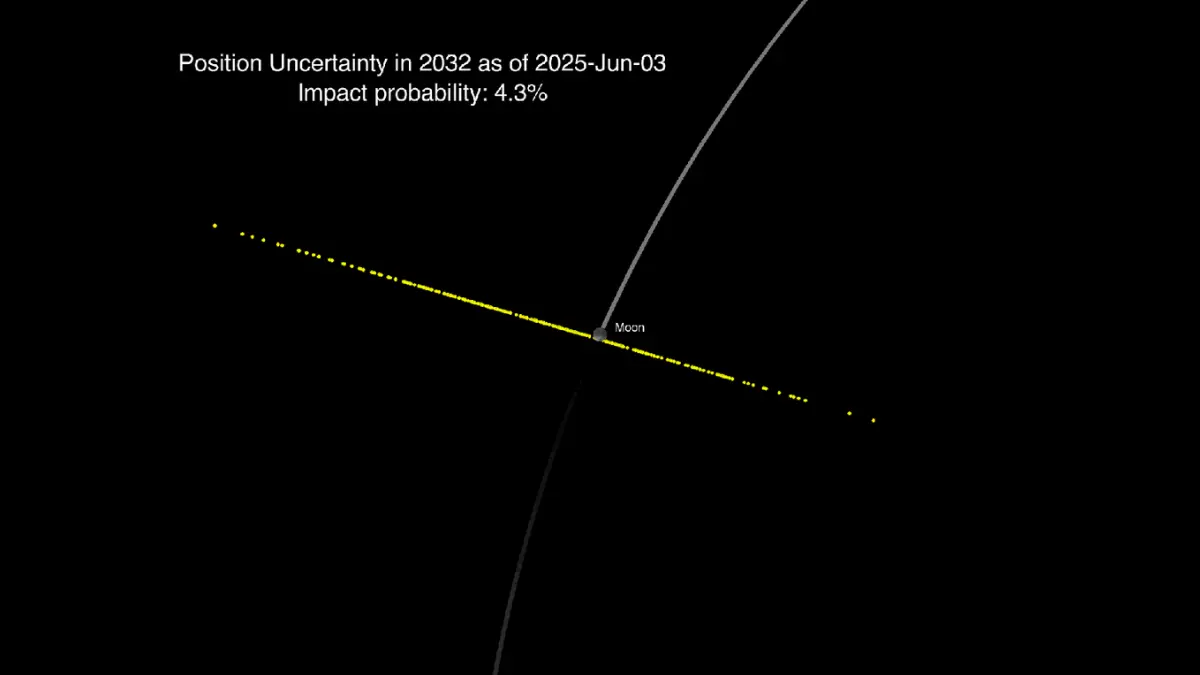
NASA scientists have confirmed that the asteroid known as 2024 YR4 will safely pass near the Moon in 2032, posing no risk to Earth, according to new observations made with the James Webb Space Telescope (JWST). The advanced infrared capabilities of Webb allowed astronomers to refine the asteroid’s orbit with greater precision than previous ground-based measurements.
Researchers used Webb to observe the object and analyze its trajectory, which helped eliminate earlier uncertainties about its long-term path through the inner solar system.
Asteroid Expected to Make a Close Lunar Flyby
Based on the latest calculations, asteroid 2024 YR4 will pass relatively close to the Moon in 2032, but the distance will still be considered safe in astronomical terms. Scientists say the asteroid will remain far enough away to avoid any gravitational disruption or collision risk.
NASA emphasized that while the asteroid will come near the Earth-Moon system, it will not intersect Earth’s orbit at a dangerous point. The updated trajectory confirms the object will simply continue its journey around the Sun after the flyby.
Why Webb’s Observations Matter
The James Webb Space Telescope is primarily designed to study distant galaxies and cosmic origins, but its highly sensitive instruments also allow it to track small objects within our solar system. Webb’s infrared vision helps astronomers measure an asteroid’s size, composition, and heat signature, improving models of how such objects move through space.
In the case of 2024 YR4, Webb’s observations significantly reduced uncertainties in its orbital calculations, giving scientists confidence in the prediction that the asteroid will pass safely by the Moon.
Planetary Defense Monitoring Continues
NASA’s Planetary Defense Coordination Office (PDCO) constantly tracks near-Earth objects (NEOs) that could potentially pose a hazard. Asteroid 2024 YR4 was initially flagged for monitoring after its discovery due to its orbital characteristics.
However, updated measurements from multiple telescopes, including Webb, have confirmed that the asteroid does not present an impact threat to Earth for at least the next century.
Scientists Stress Importance of Continued Observation
While 2024 YR4 is now considered harmless, astronomers stress that ongoing observation of near-Earth objects remains critical. Even small changes in gravitational interactions can alter asteroid paths over long periods.
By combining data from powerful observatories like Webb with ground-based telescopes and radar measurements, researchers can ensure early detection of any potential threats in the future.