
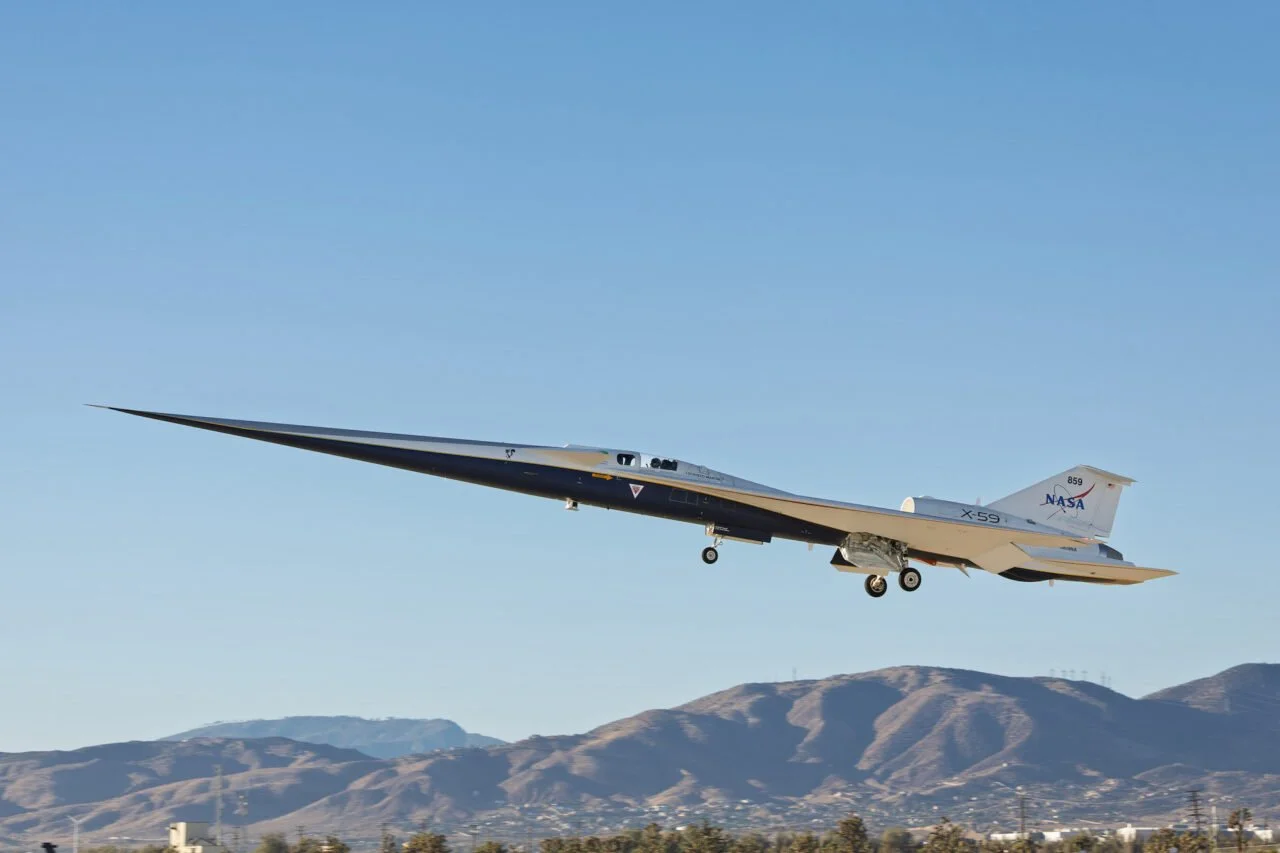
NASA’s experimental X-59 supersonic jet has officially taken to the skies for the first time, marking a defining moment in the quest to make high-speed air travel both fast and quiet. The successful test flight was conducted at Edwards Air Force Base in California, confirming that decades of research into “low-boom” technology are finally paying off.
💡 Designed for Silence: The ‘Low-Boom’ Revolution
Unlike past supersonic jets such as the Concorde, which produced thunderous sonic booms when crossing the sound barrier, the X-59 is engineered to create a gentle “sonic thump.” This is achieved through its sleek, 99.7-foot-long design, elongated nose, and precise aerodynamic shaping that disperses shock waves more evenly across the aircraft body.
The result? A sound comparable to the closing of a car door, rather than an explosive boom that once forced regulators to ban supersonic flight over land.
🤝 A NASA–Lockheed Martin Collaboration
The X-59 is the centerpiece of NASA’s Quesst mission, developed in partnership with Lockheed Martin’s Skunk Works division—famed for its history of pioneering aircraft. The mission’s objective is not just to demonstrate quiet supersonic flight but to collect data on how people on the ground perceive the noise.
This public-response data will be shared with the Federal Aviation Administration (FAA) and international regulators, potentially leading to new rules allowing supersonic flights over land in the near future.
🧪 Testing Phase and Next Steps
Following the maiden flight, NASA plans to conduct multiple test runs throughout 2025, gradually pushing the X-59 to Mach 1.4 (around 1,060 mph) at altitudes of about 55,000 feet. The gathered acoustic data will help validate the aircraft’s design and guide noise-certification standards for future commercial jets.
If all goes as planned, the X-59 could pave the way for a new generation of commercial airliners that travel between cities in half the time—New York to Los Angeles in under two hours—without disturbing communities below.
🌍 A Leap Toward the Future of Air Travel
The X-59’s success represents more than just a technological achievement—it signals a transformation in how we think about speed, sound, and sustainability in aviation. By proving that supersonic flight can be both environmentally considerate and community-friendly, NASA is reshaping the skies for generations to come.
As NASA Administrator Bill Nelson put it, “This is the sound of the future—quiet, fast, and revolutionary.”