
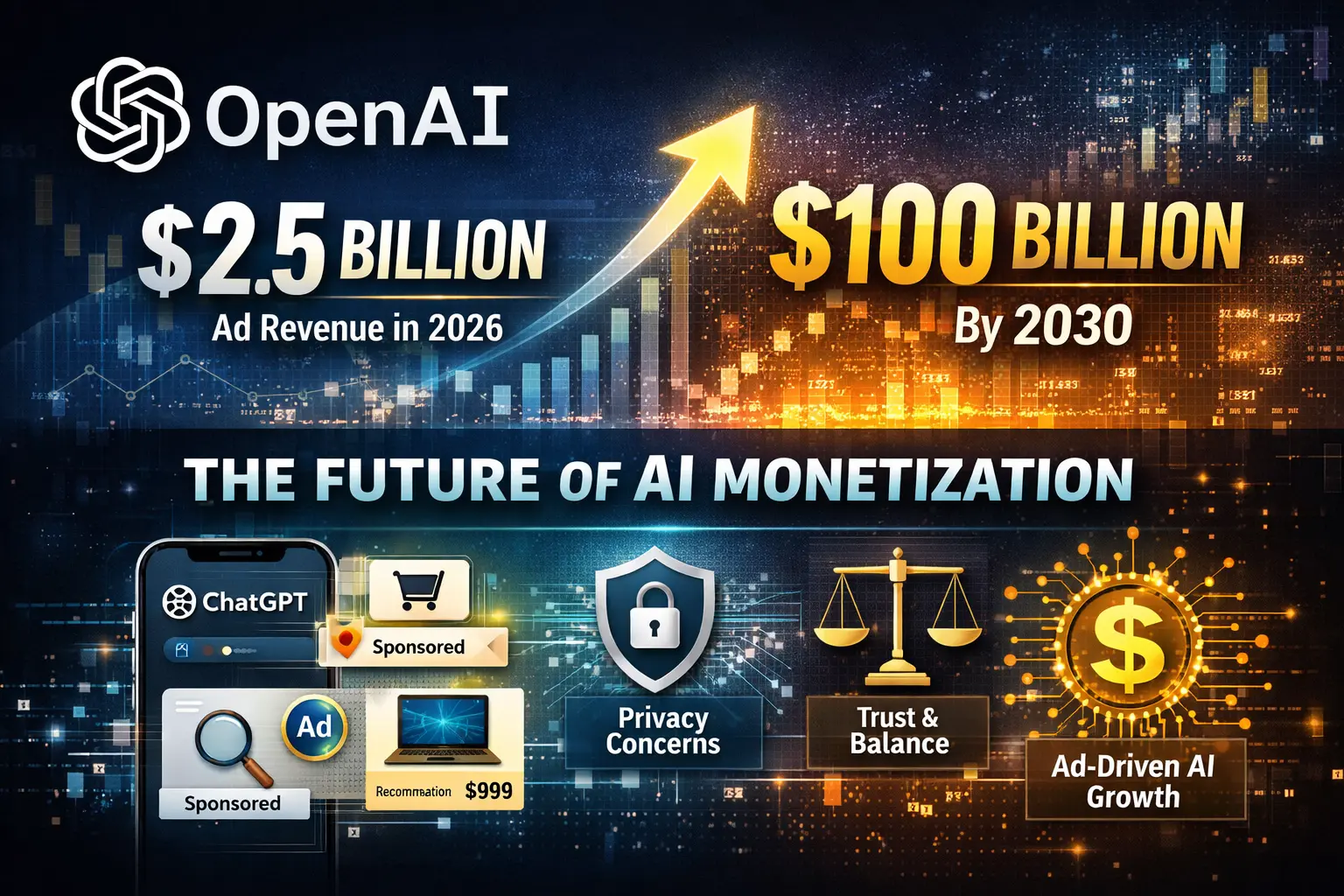
OpenAI is reportedly forecasting around $2.5 billion in advertising revenue in 2026, marking a significant shift in how the company plans to monetize its rapidly growing AI ecosystem. More notably, internal projections suggest an ambitious target of $100 billion in annual ad revenue by 2030, placing OpenAI on a trajectory to compete with the biggest players in digital advertising.
Until now, OpenAI’s revenue model has largely relied on subscriptions (like ChatGPT Plus/Enterprise) and API access for developers. Moving into advertising indicates a broader strategy: turning ChatGPT and related products into a scalable, consumer-facing platform capable of supporting ad-driven economics.
Why Advertising—and Why Now
The timing isn’t accidental. OpenAI’s user base has expanded dramatically, with hundreds of millions of weekly active users across ChatGPT and integrated services. That level of engagement creates fertile ground for advertising—especially if done in a way that blends naturally into AI-driven interactions.
From a business standpoint, ads offer:
- Massive scalability compared to subscription ceilings
- Recurring high-margin revenue streams
- A pathway to compete with Google, Meta, and Amazon in digital ads
This shift also reflects a broader industry pattern: as AI tools become daily utilities, companies are under pressure to diversify revenue beyond premium tiers.
What Could AI Advertising Look Like
Unlike traditional banner ads or feed-based promotions, advertising within AI platforms could take a very different form. Early expectations point toward:
- Context-aware recommendations embedded within responses
- Sponsored suggestions during search-like queries
- Conversational commerce integrations (e.g., product discovery within chat)
For example, a user asking for “best laptops under $1000” might receive a mix of organic recommendations and clearly labeled sponsored options.
The challenge will be balancing usefulness and transparency without eroding trust—something OpenAI has emphasized as critical to long-term adoption.
Risks: Trust, Privacy, and User Experience
Introducing ads into conversational AI isn’t straightforward. It raises several concerns:
1. Trust and Neutrality
Users rely on AI tools for objective, unbiased answers. Even subtle ad placements could lead to skepticism if not clearly disclosed.
2. Data Sensitivity
Highly personalized ads often depend on user data. OpenAI will need to navigate privacy expectations and regulatory scrutiny, especially in regions like the EU and US.
3. Experience Degradation
Over-monetization risks turning a clean, utility-driven interface into something cluttered—similar to the evolution of traditional search engines.
In short, the execution will matter more than the strategy itself.
Competitive Pressure Is Building
OpenAI isn’t moving in isolation. The AI space is quickly becoming a battleground for monetization models:
- Google is already blending ads into AI-powered search experiences
- Meta is investing heavily in AI-driven ad targeting
- Amazon continues to dominate commerce-linked advertising
If OpenAI successfully integrates ads without compromising usability, it could carve out a new category: conversational advertising platforms.
The $100 Billion Question
Reaching $100 billion in annual ad revenue by 2030 would require more than just user growth—it would demand:
- Deep integration of AI into daily workflows and decision-making
- Strong advertiser adoption and measurable ROI
- A scalable infrastructure for real-time, context-aware ad delivery
For context, only a handful of companies globally generate ad revenues at that scale today. So while the target is aggressive, it reflects the sheer size of the opportunity OpenAI is chasing.
What This Means for Users and Businesses
For users, the future of ChatGPT may include subtle commercial layers, ideally designed to enhance rather than interrupt. For businesses, it opens up an entirely new channel—one where ads are not just seen, but interacted with conversationally.
The bigger takeaway: AI platforms are evolving from tools into full-fledged digital ecosystems. And like every major platform before them, monetization at scale will likely define the next phase of growth.
Bottom Line
OpenAI’s reported ad revenue ambitions signal a pivotal shift—from a tool-based company to a platform-driven business. If executed well, it could redefine how advertising works in the AI era. If handled poorly, it risks undermining the very trust that made these tools indispensable.