
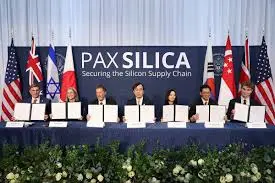
The term “Pax Silica” is increasingly being used by policymakers and analysts to describe a new global order shaped by semiconductor power—much like Pax Americana or Pax Britannica once defined geopolitical stability. In this emerging framework, countries that control chip design, fabrication, and supply chains gain disproportionate economic and strategic leverage. For India, the concept arrives at a pivotal moment, as it pushes aggressively into semiconductor manufacturing, chip design, and AI infrastructure.
Why Semiconductors Are the New Strategic Currency
Semiconductors sit at the heart of everything from smartphones and electric vehicles to missiles and generative AI systems. Global disruptions during the pandemic and rising U.S.–China tensions exposed how fragile chip supply chains really are. As a result, nations are racing to localize production. Pax Silica reflects this shift—where silicon dominance could determine national security, trade power, and technological independence.
India’s Semiconductor Push: Ambition Meets Reality
India has launched multi-billion-dollar incentive programs to attract chip fabs, OSAT (assembly and testing) units, and design ecosystems. Partnerships with companies from Taiwan, Japan, the U.S., and Europe signal serious intent. However, building a competitive semiconductor ecosystem is not just about money—it requires deep technical know-how, long timelines, reliable infrastructure, and policy stability.
The Trapdoor Risk: Dependency Disguised as Partnership
Critics warn that Pax Silica could become a high-tech trapdoor if India ends up hosting assembly plants while remaining dependent on foreign nations for advanced fabrication tools, materials, and intellectual property. Over-reliance on geopolitical allies could limit India’s strategic autonomy, especially if export controls or technology restrictions tighten in the future.
The Breakout Opportunity: From Back Office to Silicon Power
On the other hand, Pax Silica could mark India’s breakout moment. India already leads in chip design talent, software integration, and system-level engineering. If combined with domestic manufacturing and R&D, the country could leapfrog into a unique position—neither fully aligned with any single bloc nor excluded from advanced technology flows.
Geopolitics, Not Just Technology, Will Decide the Outcome
Whether Pax Silica becomes a trap or a triumph depends on how India balances diplomacy, industrial policy, and innovation. Strategic hedging—working with multiple partners while building indigenous capability—may be the key. Unlike past industrial revolutions, the silicon era leaves little room for late movers, making India’s choices in the next decade decisive.
A Defining Decade for India’s Tech Sovereignty
Pax Silica is not an abstract idea—it is unfolding in real time. For India, it represents both risk and reward. Success could elevate the country into the top tier of technological powers. Failure could lock it into a subordinate role in the global digital economy. The question is no longer whether India will participate, but on whose terms.