
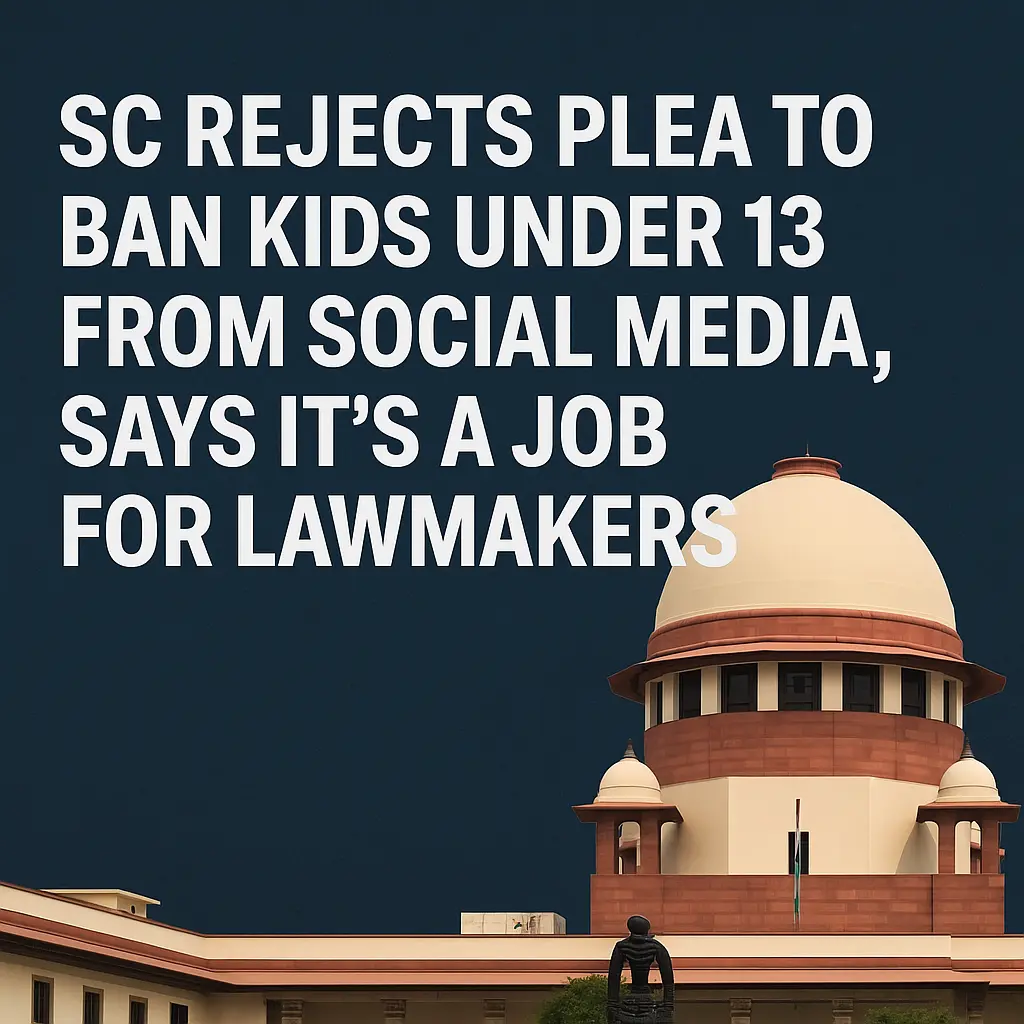
The Supreme Court of India has refused to entertain a petition seeking a nationwide ban on the use of social media platforms by children under the age of 13, asserting that such matters fall under the purview of legislative and policy-making authorities, not judicial intervention.
A Public Interest Litigation (PIL) was filed urging the court to prohibit children below the age of 13 from accessing platforms like Instagram, Facebook, YouTube, and others, citing concerns over psychological harm, exposure to harmful content, data privacy violations, and cyberbullying. The petition also claimed that many underage users bypass age restrictions through fake accounts, often with little parental oversight.
Court Observes Role of Legislature
A bench headed by Chief Justice D.Y. Chandrachud, while hearing the plea, remarked that although the concerns raised were valid and timely, it was not within the judiciary’s role to formulate digital policy or enforce age-based restrictions on digital platforms.
"This issue involves complex policy considerations related to parental control, education, enforcement mechanisms, and digital rights. These matters are better suited for legislative or executive deliberation," the court observed.
The plea was subsequently withdrawn after the bench suggested that the petitioner could approach the relevant government ministry — such as the Ministry of Electronics and Information Technology (MeitY) — for policy-level intervention.
Growing Concerns Over Youth and Social Media
The petition comes amid rising global concern about the impact of social media on children's mental health and development. Multiple studies have linked excessive screen time and social media use among pre-teens with anxiety, depression, body image issues, and reduced attention spans.
Although many platforms have a minimum age requirement of 13, enforcement remains lax. Critics argue that tech companies prioritize user growth over safeguarding young users, while parents and schools struggle to regulate screen time and online behavior.
Government and Regulatory Developments
India’s Digital Personal Data Protection Act, 2023, includes provisions for safeguarding children's data, including requirements for verifiable parental consent for users under 18. However, enforcement remains a challenge due to lack of standard verification systems and widespread non-compliance.
The government has indicated it is working on strengthening its regulatory framework, possibly inspired by global models such as the U.S. Children's Online Privacy Protection Act (COPPA) and the UK’s Age-Appropriate Design Code.
Experts believe that India’s regulatory evolution on this issue will require a coordinated approach, involving parents, educators, platforms, and policymakers — rather than a blanket ban.
What’s Next?
Though the Supreme Court has stepped aside from enforcing restrictions, the debate around child safety online is far from over. With millions of children in India actively using social media — often unsupervised — there is increasing pressure on the government to introduce clear, enforceable, and tech-driven child protection measures.
In the meantime, digital literacy campaigns, parental guidance tools, and stricter content moderation on platforms remain the primary lines of defense.
Quick Summary:
-
SC Decision: Declines plea to bar children under 13 from using social media.
-
Reason: Policy matter, not judicial enforcement.
-
Petitioner’s Route: Advised to approach government ministries for regulation.
-
Issue Raised: Child safety, data privacy, mental health.
-
Broader Impact: Highlights urgent need for robust child online safety frameworks in India.