
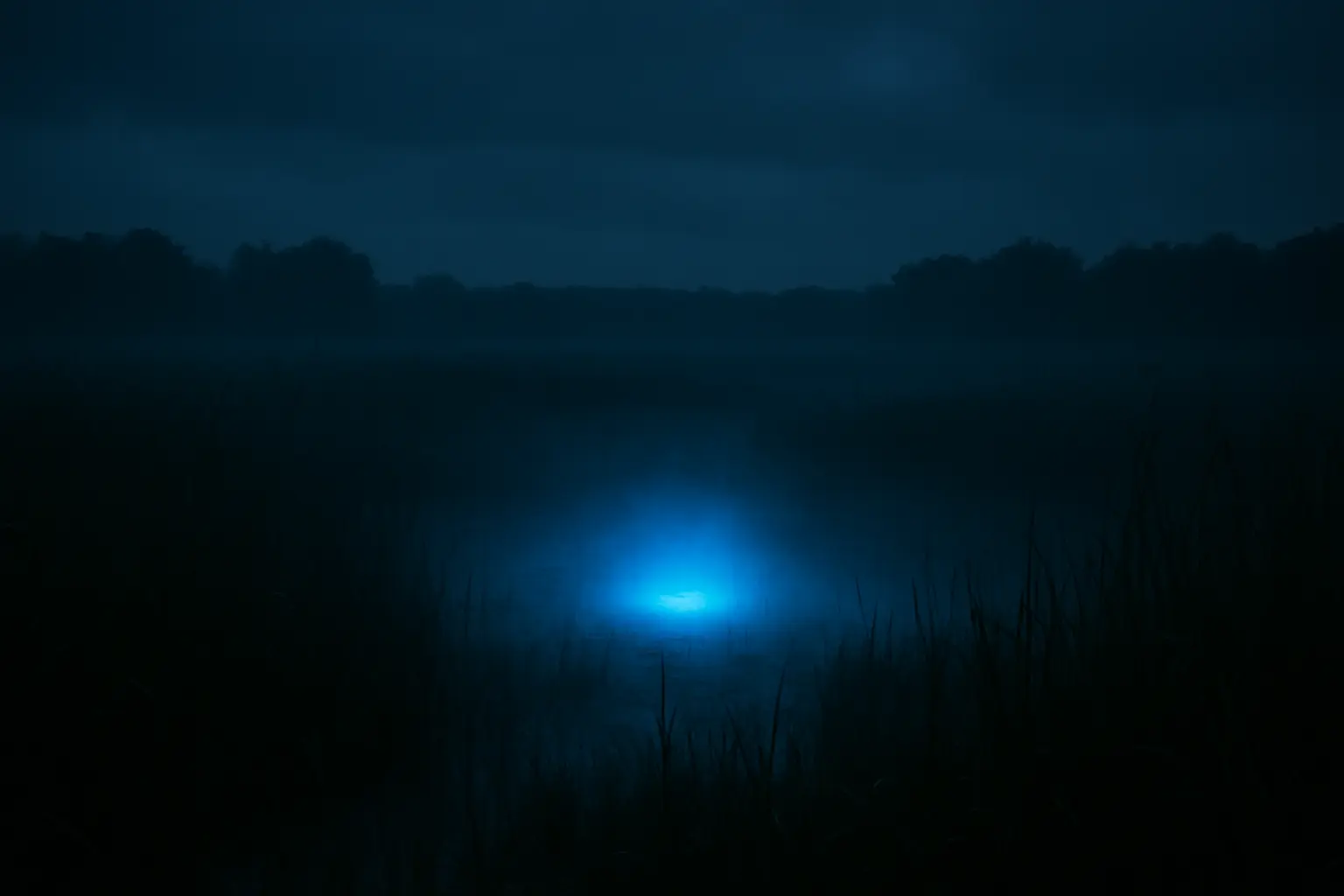
For centuries, eerie blue lights flickering across marshlands at night have puzzled locals and scientists alike. Known by various names such as will-o’-the-wisps or ghost lights, these glowing orbs were often linked to folklore or supernatural tales. Now, researchers have identified the true cause — a phenomenon they call microlightning, a form of ultra-small electrical discharge that occurs close to the ground.
Discovery Through Advanced Atmospheric Sensors
A team of atmospheric physicists from the University of Helsinki, collaborating with NASA and Japan’s RIKEN Institute, made the discovery using high-sensitivity optical sensors and radio wave detectors. During several field studies in European and North American wetlands, they recorded short-lived electrical bursts lasting less than a millisecond — strong enough to ionize gases but too weak to produce thunder or typical lightning bolts.
What Exactly Is Microlightning?
Unlike regular lightning, which spans kilometers, microlightning discharges are just a few centimeters long and occur between layers of ionized air and methane pockets near wetland surfaces. The reaction energizes nitrogen and oxygen molecules, producing an ethereal blue glow visible from a distance. These discharges often appear on humid nights when temperature gradients trap gases near the surface.
Debunking the Methane Combustion Theory
For years, the leading theory attributed marsh lights to spontaneous combustion of methane. However, repeated experiments failed to reproduce stable blue glows under natural conditions. The new microlightning hypothesis not only matches observed color and duration but also explains the phenomenon’s unpredictability and localized appearance.
Potential Implications for Climate and Energy Research
The discovery may also shed light on micro-scale electrical processes in Earth’s atmosphere, influencing local chemical reactions and possibly contributing to natural methane breakdown. Researchers suggest that understanding microlightning could improve models of atmospheric electricity and help design sensors for detecting similar low-energy discharges on planets like Mars or Titan.
Future Observations and Research Goals
The research team plans to deploy autonomous drones equipped with spectroscopy tools to map these lights in real-time. Scientists hope the findings will bridge gaps between folklore and modern science, turning once-feared ghost lights into valuable tools for understanding Earth’s delicate electrical environment.