
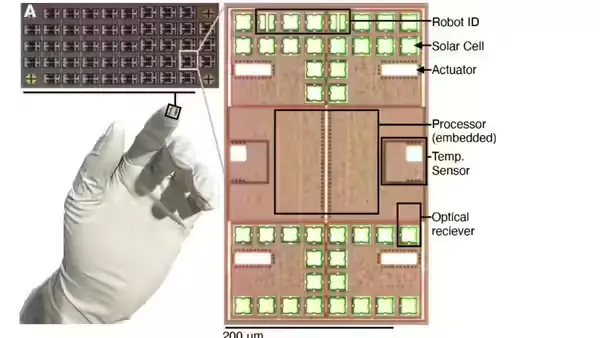
Researchers have unveiled sub-millimeter-scale robots capable of sensing their surroundings, processing information, and acting autonomously—without relying on external computers or continuous human control. The study marks a significant milestone in robotics, pushing intelligence and decision-making into machines smaller than a grain of sand.
How These Microscopic Robots Work
Unlike earlier micro-robots that depended heavily on external power or commands, the newly developed systems integrate miniature sensors, logic circuits, and actuators directly on the robot itself. This allows them to detect environmental cues such as light, temperature, or chemical changes and respond in real time using pre-programmed decision rules.
Onboard Intelligence at an Unprecedented Scale
The key innovation lies in ultra-compact computing architectures that balance power efficiency with functionality. By optimizing circuit design and energy usage, scientists have enabled basic “thinking” capabilities at a scale once thought impractical, overcoming long-standing limitations of heat dissipation and power delivery.
Autonomous Action Without External Control
These robots can independently move, change behavior, or trigger actions based on sensed data. In demonstrations, the machines adjusted their responses when environmental conditions shifted, highlighting their potential to operate in places where wireless communication or constant supervision is impossible.
Potential Applications Across Medicine and Industry
Experts suggest that autonomous sub-millimeter robots could one day be used for targeted drug delivery, minimally invasive diagnostics, environmental monitoring, or inspecting hard-to-reach industrial systems. Their small size allows them to access confined spaces that conventional robots cannot enter.
Challenges Still Ahead
Despite the breakthrough, researchers caution that large-scale deployment remains years away. Manufacturing at scale, ensuring reliability, and safely controlling swarms of such robots are challenges that must be addressed before real-world adoption.
A Glimpse Into the Future of Robotics
The study signals a future where intelligence is no longer tied to size. As components continue to shrink, autonomous machines may soon operate invisibly around us—inside the human body, deep underground, or across complex infrastructures—reshaping how robotics interacts with the world.