
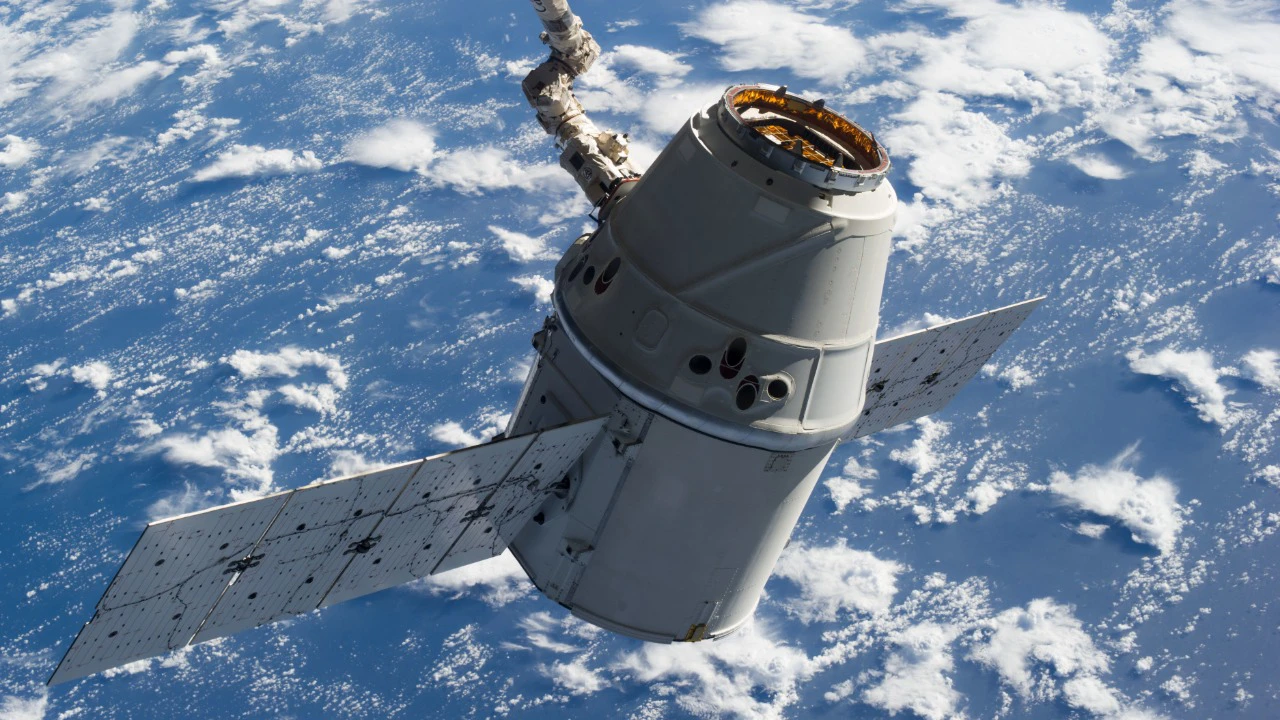
SpaceX’s Cargo Dragon spacecraft has successfully reached the International Space Station (ISS), delivering nearly 6,500 pounds of supplies, scientific experiments, and mission-critical equipment for astronauts aboard the orbiting laboratory. The docking operation represents another important achievement under NASA’s Commercial Resupply Services (CRS) program, which has become central to maintaining ISS operations.
The spacecraft launched aboard a Falcon 9 rocket from Cape Canaveral Space Force Station in Florida before autonomously traveling to the station in low-Earth orbit. After a carefully coordinated rendezvous sequence, Dragon safely docked with the ISS, where crew members are now preparing to unload its cargo.
NASA confirmed that the mission carried a mix of crew provisions, research hardware, station maintenance equipment, and advanced scientific investigations designed to support both current operations and future deep-space missions.
Scientific Research Remains a Core Focus
A major portion of Dragon’s payload includes scientific experiments that cannot be conducted under Earth’s gravity conditions. Researchers believe the microgravity environment aboard the ISS continues to provide valuable insights into biology, physics, material science, and human health.
Among the cargo are experiments related to cellular behavior, pharmaceutical development, and technologies that could support future Moon and Mars missions. NASA officials noted that several studies onboard are focused on understanding how long-duration spaceflight affects the human body — a critical area of research as agencies prepare for deeper space exploration under programs like Artemis.
Space-based research conducted aboard the ISS has historically contributed to advances in medicine, water purification systems, and materials engineering, highlighting the station’s role as more than just an orbital outpost.
Cargo Includes Essential Crew Supplies and Equipment
Beyond research payloads, the Dragon capsule transported food, clothing, medical supplies, and spare components needed to keep the station functioning smoothly. Maintaining a continuous supply chain is vital because astronauts aboard the ISS depend heavily on scheduled cargo missions for daily living and operational support.
NASA and SpaceX teams carefully plan each resupply mission months in advance, balancing scientific priorities with practical station needs. The delivered equipment also includes tools and hardware upgrades intended to improve onboard systems and support upcoming maintenance activities.
The ISS currently hosts astronauts from multiple international agencies, reinforcing the station’s role as one of the world’s largest collaborative scientific projects.
Dragon Spacecraft Continues to Prove Reliability
The Cargo Dragon spacecraft has become one of the most dependable vehicles operating in low-Earth orbit today. Unlike earlier cargo systems, Dragon is capable of returning scientific samples and equipment safely back to Earth, making it especially valuable for time-sensitive experiments.
SpaceX has steadily refined the spacecraft’s autonomous docking systems, reusability features, and recovery operations over multiple missions. Industry analysts say the company’s ability to routinely launch, recover, and relaunch spacecraft has significantly reduced operational costs across the commercial space sector.
The mission also demonstrates the continued effectiveness of reusable Falcon 9 rockets, which remain a major component of SpaceX’s launch strategy. Reusability has allowed the company to increase launch frequency while lowering mission expenses compared to traditional expendable launch systems.
NASA and SpaceX Partnership Continues to Expand
NASA’s partnership with SpaceX has evolved dramatically over the past decade. Initially focused on cargo transportation, the collaboration now includes astronaut missions, station logistics, and support for future lunar exploration efforts.
Commercial partnerships have enabled NASA to redirect resources toward ambitious exploration goals while private companies manage routine orbital transportation. Experts say this model has reshaped the global space industry and accelerated innovation across launch services and spacecraft development.
The success of repeated Dragon missions also strengthens confidence in commercial spaceflight infrastructure at a time when demand for orbital missions continues to grow from governments, research institutions, and private companies alike.
ISS Remains Critical for Future Space Exploration
Despite being operational for more than two decades, the International Space Station remains one of humanity’s most important scientific platforms. The station serves as a testing ground for technologies and human systems required for future missions to the Moon, Mars, and beyond.
Every cargo delivery contributes to maintaining that long-term scientific presence in orbit. From food supplies to cutting-edge laboratory equipment, each mission plays a direct role in ensuring astronauts can continue conducting research in space safely and efficiently.
With Dragon now securely attached to the ISS, crews are expected to spend the coming days unpacking supplies and activating scientific experiments that could shape the next generation of space exploration technologies.
Growing Commercial Space Activity Signals Industry Shift
The latest Dragon mission also reflects a broader transformation taking place within the global aerospace industry. Commercial companies are increasingly handling responsibilities once managed exclusively by government agencies, from cargo transport to satellite deployment and crewed missions.
Space analysts believe this shift is accelerating innovation, competition, and investment across the sector. As launch costs continue to decline and mission reliability improves, access to space is becoming more routine than ever before.
For NASA, reliable cargo missions like Dragon’s are essential not only for sustaining ISS operations but also for building the logistical experience needed for future long-duration exploration missions farther from Earth.