
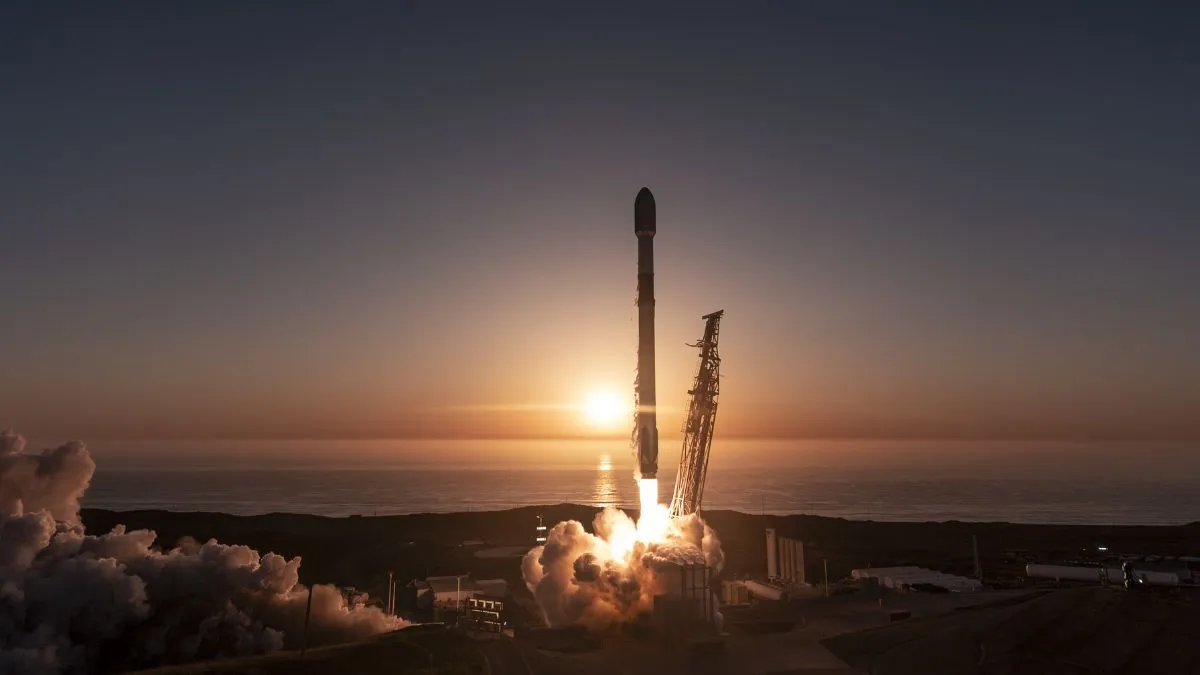
SpaceX has successfully launched another batch of 24 Starlink satellites, further expanding the company’s rapidly growing broadband constellation in low-Earth orbit. The mission, carried out using a Falcon 9 rocket, marks yet another step in SpaceX’s long-term strategy to build a global satellite-powered internet network capable of delivering high-speed connectivity across underserved and remote regions.
With the latest deployment, the total number of Starlink satellites launched by SpaceX is approaching the 10,500 mark, reinforcing the company’s dominant position in the commercial satellite internet sector.
The launch underscores SpaceX’s unmatched operational pace in the aerospace industry, where the company continues to execute missions at a frequency few competitors can currently match.
Falcon 9 Rocket Delivers Another Successful Mission
The satellites were deployed into low-Earth orbit shortly after liftoff aboard a Falcon 9 rocket. As with most modern SpaceX missions, the reusable first-stage booster completed its flight and returned safely for landing, continuing the company’s cost-saving reusability model.
Falcon 9 has become the backbone of SpaceX’s launch operations due to its proven reliability and rapid turnaround capability. The reusable rocket system has significantly lowered launch costs over the past decade, enabling the company to scale Starlink deployments at an unprecedented rate.
Industry analysts note that SpaceX’s reusable launch infrastructure remains one of its strongest competitive advantages, particularly as rival satellite internet providers struggle with deployment costs and launch scheduling.
Starlink’s Growing Global Footprint
Starlink was originally designed to provide high-speed, low-latency internet access to areas where traditional fiber or mobile infrastructure is difficult or economically impractical to deploy. Since its early beta rollout, the service has expanded into dozens of countries and now supports residential users, businesses, maritime operations, aviation connectivity, and emergency communication services.
The network has become especially important during natural disasters and regional outages, where portable Starlink terminals have been used to restore communications rapidly.
Experts say the latest satellite additions are expected to improve network capacity, reduce congestion in high-demand regions, and enhance service reliability for existing subscribers.
As the constellation grows denser, SpaceX is also moving closer to expanding its direct-to-device ambitions, a system intended to allow compatible smartphones to connect directly to satellites without requiring specialized hardware.
Nearing 10,500 Satellites Raises Industry Attention
The sheer scale of the Starlink constellation is reshaping conversations around orbital infrastructure, space regulation, and satellite traffic management. While SpaceX argues that the system is critical for expanding global internet access, astronomers and regulatory experts continue to raise concerns about orbital congestion and the long-term sustainability of mega-constellations.
Low-Earth orbit is becoming increasingly crowded as governments and private companies launch new communication satellites, Earth observation systems, and scientific missions. This has intensified calls for improved international coordination on collision avoidance and space debris mitigation.
SpaceX has repeatedly stated that Starlink satellites are equipped with autonomous collision-avoidance technology and are designed to deorbit at the end of their operational lifespan.
Still, experts believe the rapid increase in satellite deployments across the industry will require stronger global standards in the coming years.
Commercial Space Competition Intensifies
SpaceX’s continued expansion also places additional pressure on competitors in the satellite broadband market, including Amazon’s Project Kuiper, OneWeb, and regional telecom-backed initiatives.
Although rivals are accelerating their own deployment plans, SpaceX currently maintains a substantial lead in operational satellites and launch capability. The company’s vertically integrated business model — combining rocket launches, spacecraft manufacturing, and broadband services — has enabled faster execution compared to many competitors that rely on external launch providers.
Analysts suggest that Starlink’s early market dominance could give SpaceX long-term advantages in customer acquisition, infrastructure partnerships, and enterprise connectivity contracts.
Strategic Importance Beyond Consumer Internet
Beyond consumer broadband, Starlink is increasingly viewed as strategically important infrastructure. Governments, defense agencies, airlines, shipping companies, and emergency response organizations have shown growing interest in satellite-based connectivity solutions that can operate independently of terrestrial networks.
The technology’s role in military communications and disaster recovery has further elevated Starlink’s global significance. Several countries are now evaluating satellite internet systems as part of national resilience and digital infrastructure strategies.
The latest launch therefore represents more than just another satellite deployment — it reflects the broader transformation of communications infrastructure from ground-based networks toward hybrid space-enabled systems.
What Comes Next for SpaceX
SpaceX is expected to continue launching Starlink missions at a rapid pace throughout 2026 as it works toward increasing network density and expanding next-generation satellite capabilities.
Future upgrades are likely to focus on higher bandwidth capacity, improved direct-to-cell services, and enhanced performance in densely populated regions. At the same time, the company continues developing its Starship vehicle, which could eventually deploy larger numbers of satellites per mission and further reduce launch costs.
For now, the latest successful Falcon 9 mission reinforces SpaceX’s position at the center of the modern commercial space economy — one launch at a time.