
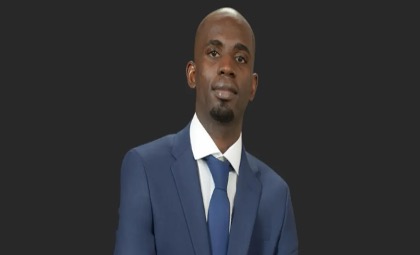
When cybersecurity professionals talk about the rapid rise of AI-enabled attacks and the growing pressure on small and medium-sized businesses (SMBs), one name keeps coming up. Yusuf Usman, a cybersecurity researcher whose research, leadership, and technical contributions are pushing the field forward in ways that matter both to industry and national security.
Usman is a member of IEEE and ASEE, and earned his M.S. in Cybersecurity from Quinnipiac University after completing a B.Sc. in Computer Science at ESGT University. His work sits at the intersection of artificial intelligence, machine learning, and real-world cybersecurity defense, a combination that has produced research now cited across academic, government, and enterprise communities.
A Study Everyone Started Downloading
Before his AI security research drew major attention, Usman made waves with a statewide study that quickly became one of the most downloaded papers of the ASEE year.
At the 2024 ASEE North East Section Conference in Fairfield, Connecticut, he presented Unveiling Cyber Threats: A Comprehensive Analysis of Connecticut Data Breaches an empirical breakdown of every publicly reported 2022 breach in the state. Using raw data from the Office of the Attorney General, he mapped out how small businesses were being hit hardest, how late detection worsened the impact, and why phishing and ransomware kept dominating the landscape.
The paper has now been downloaded well over 26,000 times, an unusually high number for a regional engineering publication. It’s been circulated among university faculty, state officials, and cybersecurity teams looking for real-world patterns rather than abstract theory.
It wasn’t just research. It was a warning, and one that landed at exactly the right time.
What stands out about his trajectory is how far-reaching his portfolio has become in such a short time. Usman’s published research spans phishing detection, malware analysis, automated cyber defense, large language model (LLM) security, and the protection of autonomous and connected vehicle systems. His work on vehicle security, presented at the IBM T.J. Watson Research Center, exposed how advanced LLMs can generate attack payloads capable of compromising modern automotive systems. That presentation earned him Best Presenter at the 2024 IEEE UEMCON Conference, a highly competitive recognition reserved for top research and delivery.
Another strand of his research focuses on building AI-powered models to detect phishing attacks with high accuracy. His custom model, CyberGPT, developed in collaboration with academic partners, reached over 97% detection accuracy and has drawn attention from both public and private cybersecurity labs. His technical papers in IEEE Xplore continue to be widely accessed, discussed, and implemented in real-world environments.
But Usman’s contributions aren’t limited to academic theory. He has also served as a technical program committee member and reviewer for several IEEE and ACM conferences, including ICCSP, ISEC, ICTMOD, IUI, and ICATEI, vetting cutting-edge papers and influencing the direction of research across disciplines like cybersecurity, AI, wireless communications, and emerging technologies.
He currently leads community and professional development initiatives as the Young Professionals Chair and State Coordinator for the IEEE Connecticut Section, where he helps shape statewide programs, advance youth engagement, and strengthen the cybersecurity talent pipeline. His leadership in IEEE has contributed to the establishment of new student branches, greater integration of young professionals, and broader technical collaboration across the state’s engineering community.
Beyond traditional research, Usman has been recognized for his innovation and academic excellence with awards such as the Excellence in Research Award and the Faculty Award for Academic Excellence in Cybersecurity. His work is now informing cybersecurity strategies for SMBs, contributing to next-generation wireless communications, and shaping academic and professional cybersecurity standards.
He has also presented award-winning work at the 2025 IEEE AIIoT Conference, where he received the Best Presenter Award for his research on Deep Reinforcement Learning for Adaptive Beamforming in Massive MIMO Systems an emerging area critical to building secure 6G networks and intelligent wireless systems.
Through it all, what defines Usman’s impact is a consistent focus on the real world. His tools, models, and research frameworks aren’t just built for labs; they are designed to help businesses, governments, and communities handle the immediate threats they face as AI-enabled cybercrime accelerates. Whether developing defenses for vehicle systems, building training models for phishing detection, or bridging gaps between academia and industry, he is shaping a vision of cybersecurity where AI is a force for protection rather than exploitation.
For a field that moves as fast as cybersecurity and in a time when digital threats continue to evolve Yusuf Usman represents a new generation of security leaders whose research and leadership are already redefining what modern cyber defense looks like.