 TECH TIMES NEWS
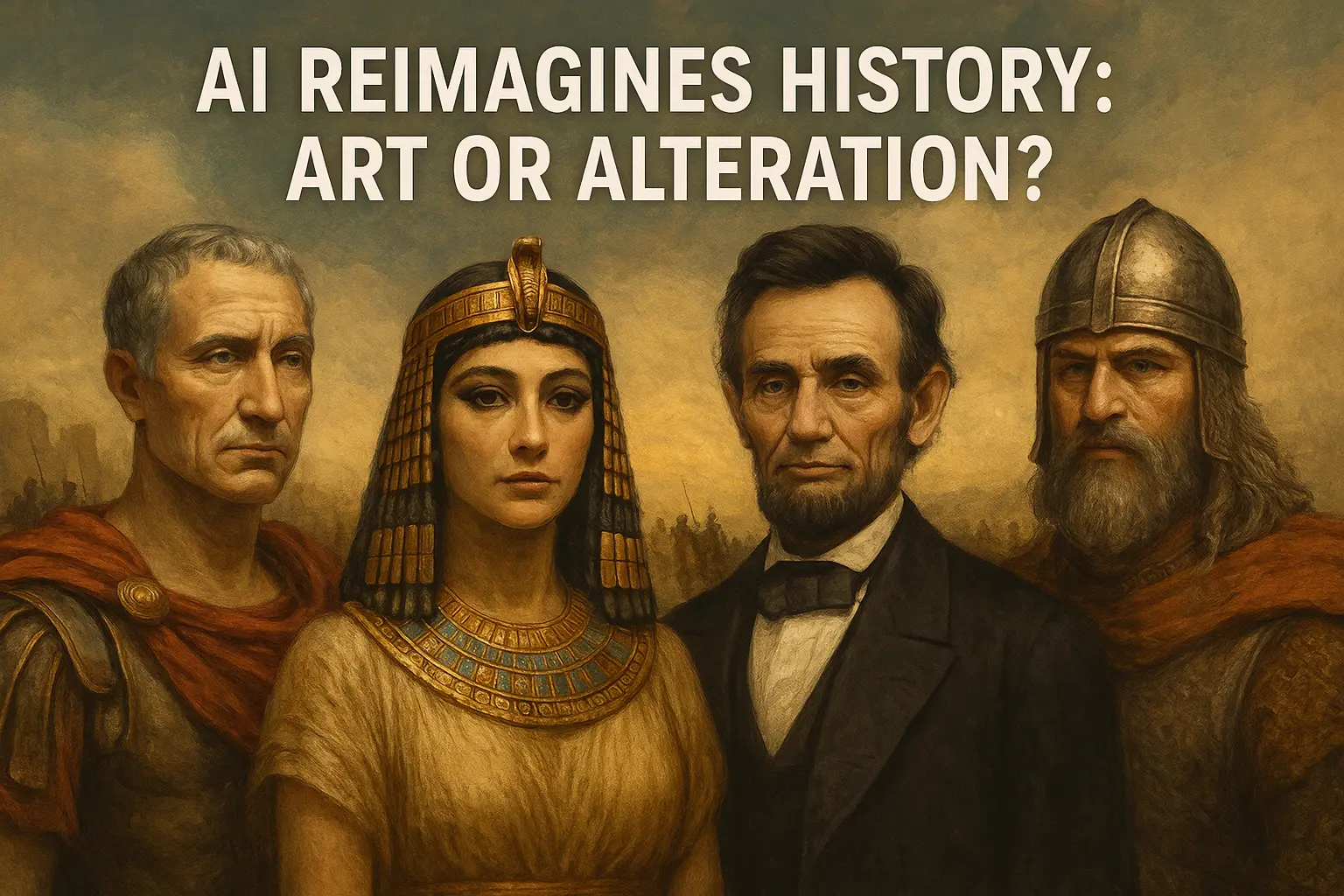
As artificial intelligence continues its rapid evolution, it’s not just future-facing content that’s taking shape. Increasingly, content creators are turning their attention to the past—using powerful AI tools to generate hyper-realistic images of historical figures and events. From lifelike renderings of Julius Caesar to imagined photographs of the Mahabharata war, AI is bringing the past to life in ways that were once the domain of museums and movie studios.
But this new wave of digital historical storytelling raises a pressing question: Are these AI-generated images enhancing public interest in history, or are they subtly distorting it?
📷 The Rise of AI-Generated History
Fueled by platforms like MidJourney, DALL·E, and Stable Diffusion, artists and enthusiasts are now capable of creating remarkably vivid representations of people who lived centuries ago—many of whom were never photographed or painted during their lifetimes. These images often go viral across platforms like Instagram, TikTok, and X (formerly Twitter), where captions like “This is what Cleopatra really looked like” accompany stunning portraits crafted entirely by machine learning.
Creators often use AI not only for entertainment but also for educational content, pairing their images with historical facts. One creator recently generated a series of AI portraits of Mughal emperors alongside short documentaries, garnering millions of views.
🧠 A New Kind of Historical Imagination
To some, this trend represents a democratization of historical exploration. "People are engaging with history in ways they never did before," says Dr. Aarti Verma, a cultural historian based in Delhi. "AI imagery is helping younger audiences visualize the past beyond dry textbooks."
Educators and history buffs have echoed this sentiment, suggesting that visually immersive content can act as a gateway to deeper learning—particularly when it's used responsibly and in conjunction with verified sources.
⚠️ Blurring the Line Between Fact and Fiction
However, concerns are growing within the academic community. Unlike documentaries or films that openly declare creative license, AI-generated images often appear deceptively authentic. Without proper context, viewers may misinterpret stylized or biased portrayals as historically accurate.
"An AI model trained on biased data can just as easily reinforce colonial stereotypes or Eurocentric ideals," warns Prof. Daniel Hughes, an AI ethics researcher at the University of Edinburgh. "If you ask it to generate an image of a 'medieval king,' it might default to a Western archetype—ignoring other global histories entirely."
The viral nature of these images only compounds the issue. With algorithms favoring engaging visuals over nuanced content, misinformation can spread quickly—especially when AI-generated images are presented without disclosure.
🧾 The Case for Disclosure and Digital Literacy
While AI art has unlocked creative opportunities, experts are calling for clearer guidelines and education. Platforms like Instagram and YouTube have begun testing AI-disclosure tags, but adoption remains inconsistent. Historians argue that every AI-generated historical image should come with transparent labeling and context—ideally referencing the sources or assumptions used to construct the image.
Some creators have taken the lead themselves. One popular digital historian includes disclaimers such as “AI interpretation — not an authentic photograph” on all images, alongside citations from academic sources.
🧭 A Tool, Not a Time Machine
Ultimately, AI-generated images of historical events and figures fall somewhere between education and entertainment. They are tools—powerful and evocative, but not immune to misuse. As these creations flood timelines and educational feeds alike, the burden will fall on creators, educators, and platforms to ensure that AI art invites curiosity without rewriting the past.
"AI can't bring us the truth of history," says Dr. Verma. "But if used with care, it can help us get closer to asking the right questions about it."