 TECH TIMES NEWS
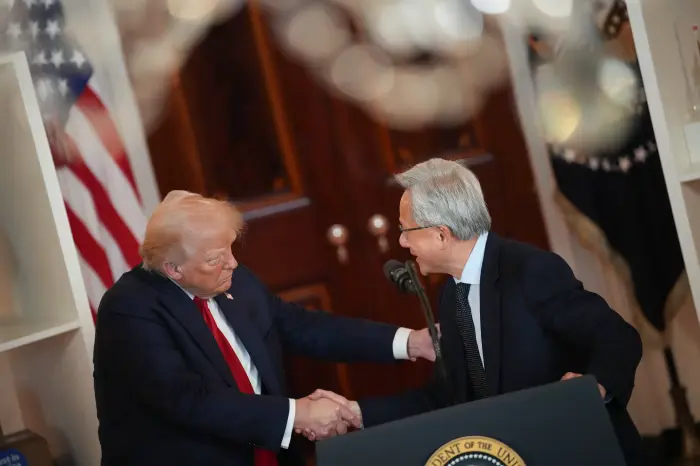
Nvidia CEO Jensen Huang has revealed that the company plans to resume sales of its artificial intelligence (AI) chips in China, following a closed-door meeting with former U.S. President Donald Trump. The disclosure was made during a press interaction after Huang’s visit to Washington, D.C., where the semiconductor giant is actively navigating regulatory hurdles to maintain its foothold in the global AI race.
Impact of U.S. Export Restrictions
In recent years, Nvidia faced restrictions under U.S. export control laws that limited the sale of high-end chips to China, primarily aimed at curbing Beijing’s access to cutting-edge AI technologies. These regulations, intensified during the Biden administration, significantly impacted Nvidia's revenue streams from Asia, particularly for its H100 and A100 series GPUs used in advanced AI systems.
Trump’s Growing Influence on Tech Policy
While not currently in office, Trump’s influence in shaping future U.S. trade policy remains strong amid his 2024 presidential campaign. According to sources close to the discussion, Trump showed openness to revising the restrictions, citing economic competitiveness and job creation. Huang reportedly received verbal assurance that a shift in policy could be expected if Trump returns to office.
CEO Highlights Need for Balanced Trade
Speaking on the matter, Huang stated, “We believe in open markets and innovation-driven progress. Artificial intelligence should be a force for global good, and we’re hopeful that trade policies will reflect that vision.” He added that discussions with Trump were productive and forward-looking, giving Nvidia confidence to re-engage in the Chinese market.
China: A Critical Market for AI Expansion
China remains one of the largest global consumers of AI hardware. With its rapid expansion in smart manufacturing, autonomous systems, and generative AI platforms, demand for Nvidia’s chips is expected to surge. The company has already been developing scaled-down models specifically designed to comply with U.S. restrictions, but full access to its flagship chips could reignite growth in the region.
Uncertainties Still Loom
Despite the announcement, industry analysts caution that policy implementation will depend on multiple factors, including election outcomes, congressional approval, and geopolitical stability. The current Biden administration has yet to comment on Nvidia's latest decision or whether export controls will be eased in the near term.
Industry Reactions and Market Impact
The news sparked a positive response on Wall Street, with Nvidia shares climbing over 2% in after-hours trading. Tech investors see this development as a potential turning point in the U.S.-China tech rivalry. Experts believe Nvidia’s move could encourage other American semiconductor firms to push for a more flexible trade regime.