 TECH TIMES NEWS
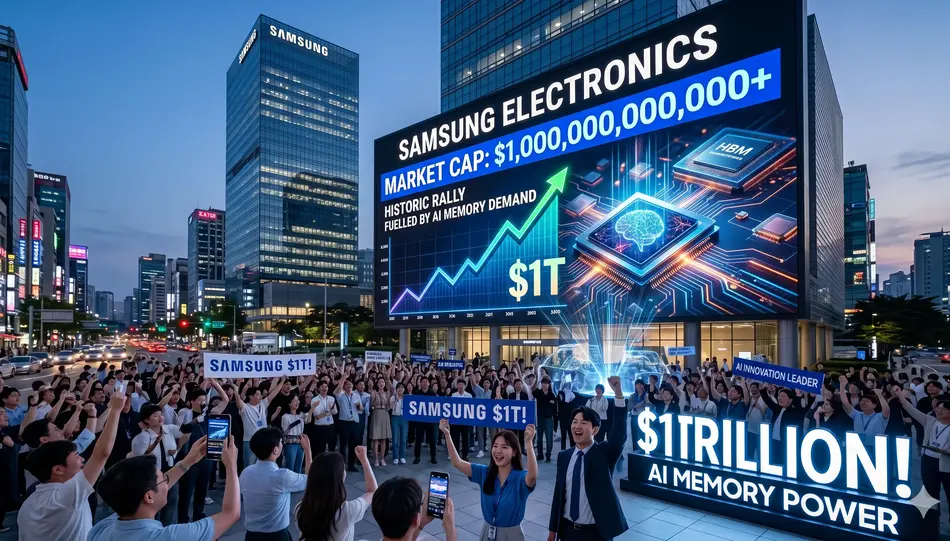
Samsung Electronics has crossed the $1 trillion market capitalization milestone, marking one of the strongest recoveries in the company’s recent history as artificial intelligence-driven chip demand continues to reshape the global semiconductor industry.
The South Korean technology giant saw its shares surge amid rising optimism around high-bandwidth memory (HBM) chips, advanced DRAM products, and AI infrastructure spending. Investors are increasingly betting that Samsung will become one of the biggest beneficiaries of the global AI expansion led by companies building data centers, generative AI systems, and cloud computing infrastructure.
The milestone places Samsung among a select group of global technology companies valued above $1 trillion, reinforcing its influence across semiconductors, smartphones, consumer electronics, and next-generation computing technologies.
Memory Chip Demand Becomes the Biggest Growth Driver
The biggest catalyst behind Samsung’s rally has been the explosive demand for memory chips used in AI servers. High-bandwidth memory, commonly known as HBM, has become one of the most critical components powering advanced AI accelerators and GPUs.
Companies such as Nvidia, AMD, Microsoft, Amazon, and Google are rapidly expanding AI infrastructure, creating an unprecedented surge in demand for advanced semiconductor components. This trend has sharply lifted pricing power across the memory industry after a prolonged downturn that affected chipmakers during 2022 and 2023.
Samsung, the world’s largest memory chip producer, is now benefiting from improving DRAM prices, stronger enterprise demand, and renewed investor confidence in the semiconductor cycle.
Analysts say the AI boom has effectively accelerated the recovery of the global memory market much faster than previously expected.
Competition With SK Hynix Intensifies
Despite the valuation milestone, Samsung still faces intense competition from domestic rival SK Hynix, which currently holds a strong position in supplying HBM chips to Nvidia.
Over the past year, SK Hynix emerged as one of the biggest winners of the AI infrastructure race after becoming a key supplier for Nvidia’s AI accelerators. Samsung has been working aggressively to close the gap by improving yields, expanding advanced packaging capabilities, and increasing production of next-generation HBM3E memory.
Industry experts believe Samsung’s long-term advantage lies in its scale, diversified semiconductor portfolio, and ability to integrate memory production with foundry manufacturing and advanced chip packaging.
The company is also investing heavily in research and development to strengthen its competitiveness in AI-focused semiconductor technologies.
Investors Regain Confidence in Samsung’s Chip Strategy
Samsung’s trillion-dollar valuation reflects a broader shift in investor sentiment toward semiconductor companies tied to artificial intelligence growth.
Just two years ago, the company faced slowing smartphone sales, weak consumer electronics demand, and a severe downturn in memory chip pricing. However, the rapid commercialization of generative AI technologies has dramatically changed market expectations.
Institutional investors now view AI semiconductors as one of the most strategically important sectors in the global economy. As a result, companies capable of supplying advanced memory, AI accelerators, and data center infrastructure are attracting significant capital inflows.
Samsung’s strong cash reserves and manufacturing scale have further strengthened confidence that it can remain competitive even as the semiconductor race becomes more capital intensive.
Foundry Expansion Remains a Critical Challenge
While Samsung dominates memory chips, its foundry business still faces major challenges against Taiwan Semiconductor Manufacturing Company (TSMC), which remains the global leader in contract chip manufacturing.
Samsung has invested billions of dollars into expanding advanced manufacturing nodes, including 3nm and next-generation process technologies. The company is also increasing investments in the United States and South Korea to secure long-term semiconductor leadership.
However, attracting large foundry customers remains critical. Industry observers say Samsung’s ability to compete with TSMC in AI chip manufacturing will play a major role in determining whether the company can sustain long-term valuation growth.
The semiconductor industry is entering a phase where manufacturing capability, supply chain resilience, and AI-related innovation are becoming deeply interconnected.
AI Is Reshaping the Global Technology Market
Samsung’s rise above the $1 trillion valuation mark highlights how artificial intelligence is transforming the structure of the global technology industry.
Chipmakers have become central players in the AI economy, with demand for GPUs, memory chips, networking hardware, and advanced servers rising rapidly across multiple sectors. Governments and corporations worldwide are also increasing investments in AI infrastructure to strengthen technological competitiveness.
The market rally seen across semiconductor companies reflects expectations that AI adoption is still in its early stages. Analysts believe spending on AI data centers, cloud platforms, and enterprise AI systems could continue expanding over the next decade.
For Samsung, the current momentum represents more than a short-term stock rally. It signals a broader strategic shift where semiconductors — particularly AI memory technologies — are becoming the company’s most valuable growth engine.
What This Means for the Tech Industry
Samsung crossing the $1 trillion market value threshold is not only a symbolic achievement but also a reflection of how critical semiconductors have become in the AI era.
The development underscores three major industry trends:
- AI infrastructure spending is accelerating globally
- Memory chips are now strategic assets in the AI race
- Semiconductor leadership is increasingly tied to geopolitical and economic power
As competition intensifies among Samsung, TSMC, SK Hynix, Nvidia, and other global chip giants, the next phase of the AI revolution is likely to be shaped as much by semiconductor manufacturing capacity as by software innovation itself.
Samsung’s latest milestone therefore represents both investor optimism and a broader transformation unfolding across the global technology economy.