 TECH TIMES NEWS
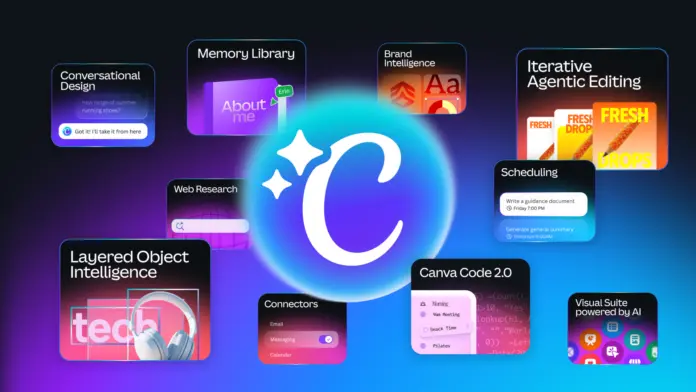
Canva has officially introduced AI 2.0, marking a significant evolution from a template-driven design platform to an intelligent, agent-like creative system. The update centers on enabling users to interact with their designs through natural language, effectively turning Canva into a collaborative assistant rather than just a tool.
This shift reflects a broader industry trend where software is becoming agentic—capable of understanding intent, executing tasks autonomously, and iterating based on user feedback. For Canva, this positions the company closer to competitors in the AI productivity space, not just traditional design software providers.
Conversational Editing: Designing Through Dialogue
At the core of Canva AI 2.0 is its conversation-based editing system. Instead of manually tweaking elements like text size, color schemes, or layout alignment, users can now simply type commands such as:
- “Make this presentation more modern and minimal”
- “Adjust this post for Instagram format with bold fonts”
- “Add a professional tone and improve readability”
The AI interprets these prompts and applies contextual changes across the design. This reduces friction, especially for non-designers, and significantly speeds up the creative process.
More importantly, the system supports iterative dialogue, meaning users can refine outputs step-by-step—similar to working with a human designer.
Agentic Features: From Tool to Task Executor
The “agentic” layer in Canva AI 2.0 goes beyond simple prompt-response interactions. It introduces systems that can:
- Analyze design intent and audience context
- Suggest improvements proactively
- Execute multi-step tasks (e.g., resizing, rewriting, reformatting simultaneously)
- Maintain consistency across multi-page or multi-format projects
This means Canva can now function as a task executor, not just a passive tool. For example, a user creating a marketing campaign can generate social posts, presentations, and ad creatives in a unified style with minimal manual intervention.
Integration With Existing AI Ecosystem
Canva has been steadily building its AI stack through features like Magic Write, Magic Design, and background removal tools. AI 2.0 appears to unify and extend these capabilities into a more cohesive system.
The update likely leverages advances in large language models and multimodal AI, enabling text, layout, and visual elements to be edited simultaneously. This convergence is critical, as modern design workflows increasingly demand cross-format adaptability.
Impact on Creators, Businesses, and Teams
For individual creators, Canva AI 2.0 lowers the barrier to producing professional-quality content. Beginners can now generate polished outputs without deep design knowledge.
For businesses, especially small and medium enterprises, the implications are more strategic:
- Faster campaign creation
- Reduced reliance on dedicated design teams
- Improved brand consistency through AI-assisted templates
- Scalable content production across platforms
Teams also benefit from collaborative AI workflows, where multiple users can interact with the same design using conversational inputs, streamlining feedback cycles.
Competitive Landscape: Canva vs AI Design Rivals
Canva’s move comes amid increasing competition from AI-driven creative platforms, including tools integrated into productivity suites and standalone generative design apps.
What differentiates Canva is its massive user base and ease of use, combined with these new AI capabilities. By embedding agentic AI directly into its interface, Canva avoids forcing users to switch tools—an advantage that could accelerate adoption.
However, the challenge will be maintaining output quality and ensuring the AI’s decisions align with professional design standards, especially for enterprise users.
Risks and Limitations to Watch
While the update is promising, there are potential concerns:
- Over-reliance on AI could reduce originality in design
- AI-generated outputs may lack nuanced brand identity without careful input
- Data privacy and content ownership remain ongoing questions in AI platforms
- Advanced users may find limitations in fine-grained control
These factors will determine how widely Canva AI 2.0 is adopted across professional environments.
What This Means Going Forward
Canva AI 2.0 signals a clear direction: design tools are evolving into intelligent collaborators. The ability to create, edit, and refine content through conversation is likely to become a standard feature across creative platforms.
For users, the takeaway is straightforward—design is becoming more accessible, faster, and increasingly automated. For the industry, Canva’s update reinforces the shift toward AI-native workflows, where intent matters more than technical skill.