 TECH TIMES NEWS
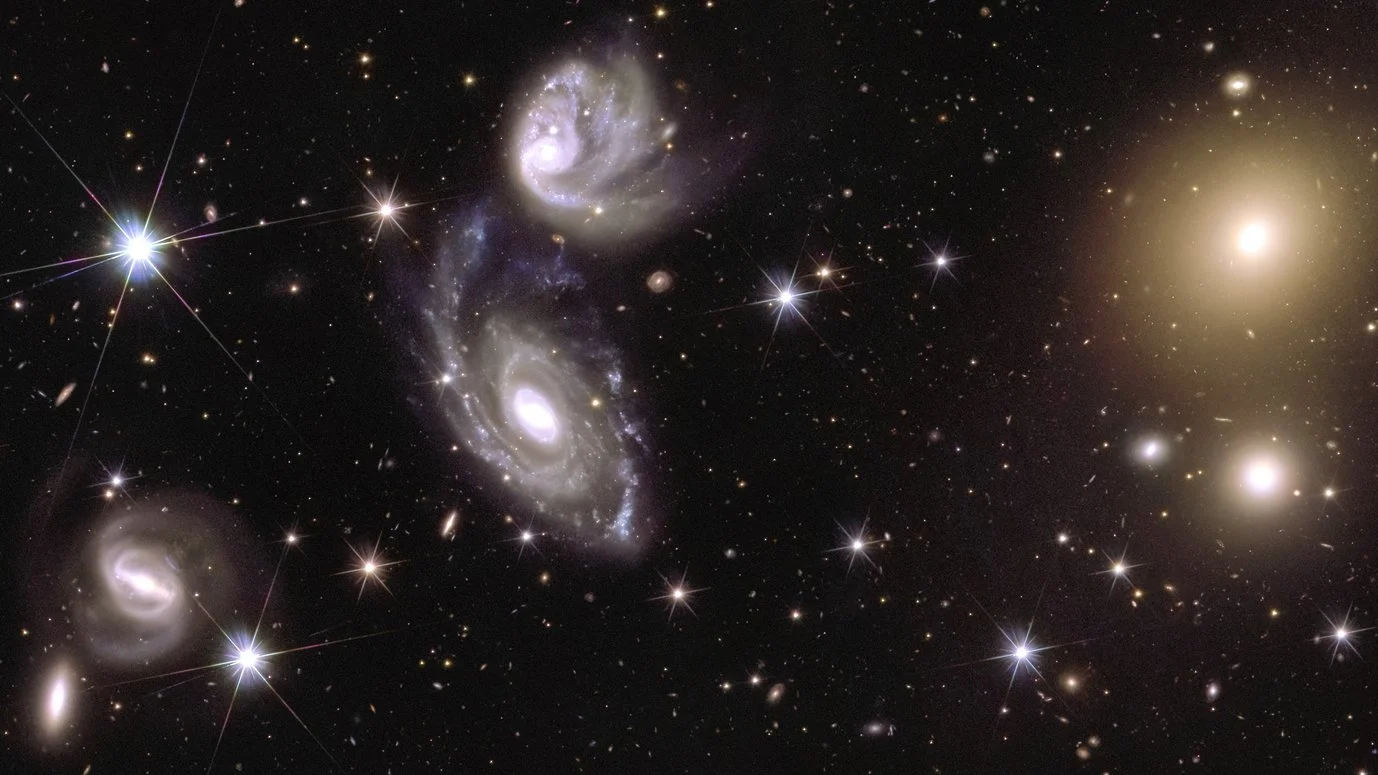
The European Space Agency (ESA) has unveiled the first major dataset from its Euclid space telescope, marking a milestone moment in cosmology. The release contains detailed observations of over one million galaxies, captured during the mission’s early operations. Scientists say this is the clearest wide-field window yet into the dark, uncharted regions of the Universe.
🛰 A Mission Designed to Unveil Dark Matter & Dark Energy
Launched in 2023, Euclid was engineered with a singular purpose: to create the most comprehensive 3D map of the cosmos ever attempted. With its visible-light imager and near-infrared spectrometer, the telescope is specifically tuned to detect subtle distortions caused by dark matter and trace the accelerating expansion driven by dark energy.
🔍 Highlights of the Newly Released Dataset
ESA’s first public data release includes an impressive collection of images, spectroscopic measurements, and early scientific analyses.
Key highlights include:
-
Deep-field images revealing galaxies billions of light-years away
-
Early detections of galaxy clusters, filaments, and cosmic voids
-
High-precision measurements of galaxy shapes and redshifts
-
Rich spectral data ideal for tracing cosmic expansion history
Researchers emphasize that this dataset is only the beginning, representing a fraction of what Euclid will observe over its six-year survey.
📈 A Leap Forward in Mapping the Cosmic Web
Astronomers around the world are already digging into the massive dataset. The ability to chart galaxy shapes with such precision across such a wide area gives scientists newfound power to reconstruct the cosmic web—the large-scale structure formed by dark matter scaffolding.
This is crucial for testing theories about how the Universe evolved and how invisible forces shaped its destiny.
🔬 Early Findings Hint at New Discoveries
Although the mission is in its early stages, scientists report promising hints of unexpected structures and variations in galaxy distribution. Euclid’s sharp vision is revealing phenomena too subtle for earlier space observatories to detect, raising anticipation that the mission could challenge or refine current models of cosmology.
🌍 A Worldwide Collaboration
Thousands of researchers across Europe, the U.S., and Asia contributed to analyzing the early data. The Euclid Consortium—comprising over 2,000 scientists and engineers—has prepared initial scientific papers outlining the telescope’s capabilities and previewing the breakthroughs ahead.
🚀 What Comes Next
Over the next six years, Euclid will scan more than one-third of the entire sky, mapping billions of galaxies in 3D. Each new release is expected to deepen humanity’s understanding of dark matter, dark energy, galaxy formation, and the Universe’s fate.