 TECH TIMES NEWS
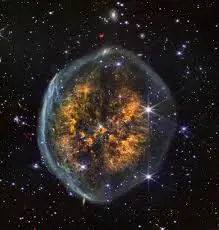
The James Webb Space Telescope (JWST) has once again demonstrated its transformative power in space observation by capturing a mesmerizing infrared image of the Cranium Nebula. Located thousands of light-years away, the nebula appears in a haunting, skull-like formation when viewed in infrared wavelengths — a perspective that reveals details previously concealed by thick cosmic dust.
Astronomers describe the new image as one of the most detailed views ever recorded of this dramatic region of space. The nebula’s intricate structures, glowing gas filaments, and embedded young stars are now visible with remarkable clarity.
Infrared Vision Pierces Through Cosmic Dust
Unlike optical telescopes, Webb specializes in infrared astronomy, allowing it to look through dense clouds of gas and dust that obscure visible light. In this latest observation, Webb’s Near-Infrared Camera (NIRCam) and Mid-Infrared Instrument (MIRI) worked together to highlight complex layers of ionized gas and cooler molecular regions within the nebula.
The infrared view exposes stellar nurseries — regions where new stars are actively forming. Bright knots within the nebula mark protostars in early developmental stages, offering researchers a rare opportunity to study how massive stars influence their surrounding environment.
Clues to Stellar Life Cycles
Scientists believe the Cranium Nebula is shaped by intense radiation and stellar winds emitted by massive young stars. These energetic forces carve cavities and sculpt the surrounding gas into dramatic formations. The skull-like appearance is likely the result of shockwaves and radiation pressure interacting with uneven gas densities.
By analyzing the spectral data gathered by Webb, astronomers aim to better understand the chemical composition of the nebula, including the presence of complex organic molecules and ionized hydrogen regions. Such studies help refine models of star formation and stellar evolution.
A New Era of Cosmic Discovery
Since its launch, the James Webb Space Telescope has consistently pushed the boundaries of astronomical research. This latest image of the Cranium Nebula underscores Webb’s ability to reveal hidden cosmic processes with unprecedented detail.
Researchers say the data collected will fuel years of scientific investigation, potentially uncovering insights into how massive stars are born, evolve, and ultimately reshape their galactic neighborhoods.