 TECH TIMES NEWS
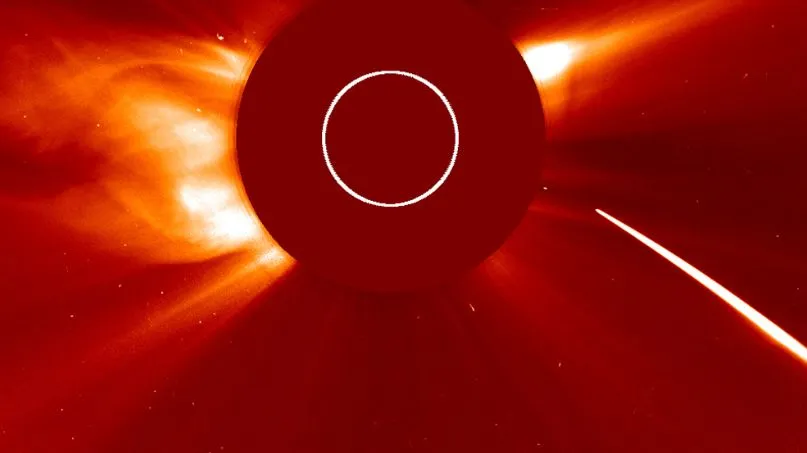
NASA scientists have recorded the dramatic disintegration of a rare “sungrazer” comet as it ventured perilously close to the Sun, marking one of the more striking observations in recent solar studies. Sungrazers are a unique class of comets that follow highly elongated orbits, bringing them extremely close to the Sun’s surface—often within a few million kilometers.
This particular comet was tracked using data from solar observatories, including instruments designed to monitor the Sun’s corona. As it approached its closest point, the comet rapidly brightened before fragmenting and eventually vanishing, unable to withstand the Sun’s intense environment.
What Makes Sungrazers So Unique
Sungrazer comets are typically fragments of larger parent bodies that broke apart centuries ago. Many belong to the Kreutz group, a family of comets believed to originate from a massive progenitor that disintegrated long ago.
Their defining trait is their extremely close approach to the Sun—sometimes passing within 1–2 million kilometers of the solar surface. At such distances, temperatures can soar beyond several thousand degrees Celsius, while gravitational tidal forces exert immense stress on the comet’s fragile icy structure.
Why This Comet Didn’t Survive
Extreme Heat and Tidal Forces at Play
As the comet neared perihelion (its closest point to the Sun), it encountered a combination of destructive forces. Solar radiation rapidly heated its icy nucleus, causing volatile materials like water ice, carbon dioxide, and methane to vaporize almost instantly.
At the same time, the Sun’s gravitational pull created powerful tidal stresses, effectively stretching and breaking the comet apart. This dual assault—thermal evaporation and mechanical fragmentation—led to its complete disintegration before it could exit the Sun’s vicinity.
Scientists note that only a small fraction of sungrazers survive such encounters, and those that do are typically larger and denser.
How NASA Observed the Event
Solar Observatories Provide Crucial Data
The event was primarily observed through space-based solar missions such as NASA and ESA’s Solar and Heliospheric Observatory (SOHO), along with complementary data from other heliophysics missions.
These instruments use coronagraphs, which block the Sun’s bright disk to reveal faint nearby objects, making it possible to detect comets that would otherwise remain invisible. The comet’s brightening, fragmentation, and eventual disappearance were captured over a short observational window, providing valuable time-series data.
Scientific Insights and Broader Implications
Understanding Comet Composition and Solar Dynamics
Events like this offer scientists a rare natural experiment. By analyzing how quickly the comet disintegrated and how its brightness changed, researchers can infer its composition, density, and internal structure.
Moreover, sungrazers serve as probes of the solar environment. As they break apart, their material interacts with the solar corona, helping scientists study magnetic fields, solar wind behavior, and particle interactions in extreme conditions.
Why These Observations Matter
Improving Models of the Solar System
Studying sungrazers enhances our broader understanding of the solar system’s evolution. These comets are remnants from its earliest days, preserving primitive material that predates the planets.
Tracking their destruction also helps refine predictive models of comet trajectories and lifespans—critical for both scientific research and planetary defense strategies involving near-Earth objects.
A Brief but Valuable Cosmic Encounter
While the comet’s life ended in a fiery plunge, the data it provided will have lasting value. Each such observation adds a piece to the puzzle of how small bodies behave under extreme conditions.
NASA researchers emphasize that continued monitoring of sungrazers will likely reveal more such events, each offering new insights into the complex interplay between the Sun and the icy remnants orbiting it.
Conclusion
The disintegration of this sungrazer comet highlights both the destructive power of the Sun and the scientific opportunity such events present. Captured through advanced solar observation technology, the event not only showcases the dynamic nature of our solar system but also deepens our understanding of comet physics and solar interactions.