 TECH TIMES NEWS
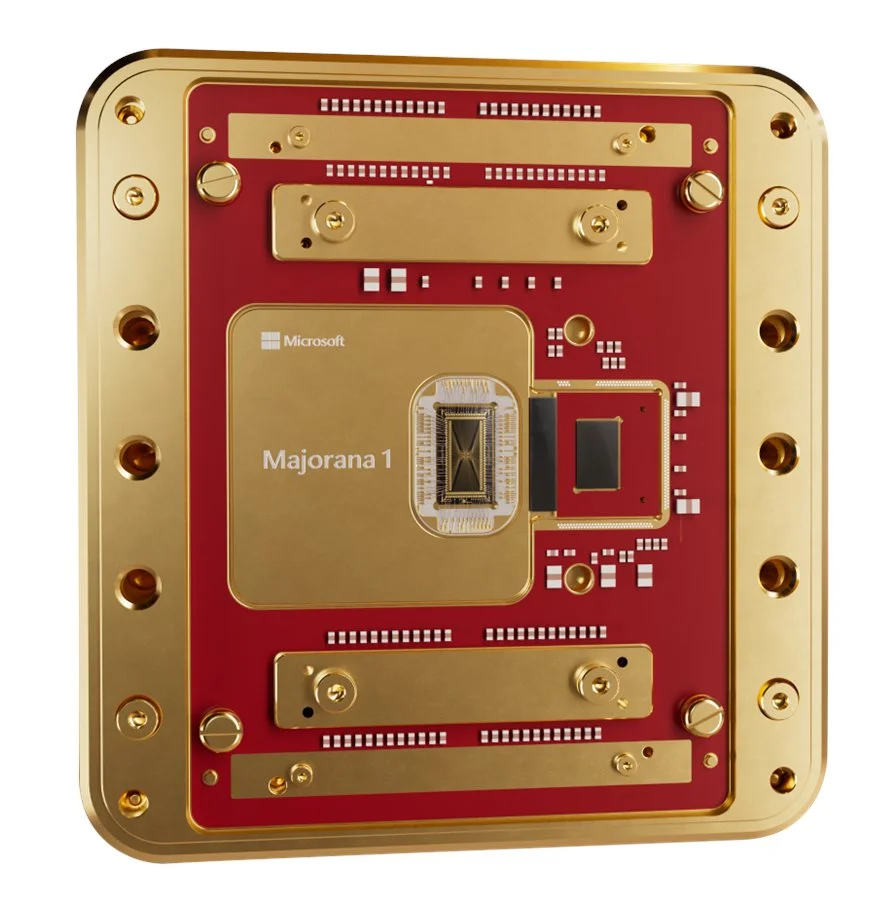
February 2025 – In a ground-breaking announcement on Wednesday, Microsoft introduced its latest innovation in quantum computing—the Majorana 1 chip—claiming that practical quantum computing is now "years, not decades" away. The move places Microsoft in direct competition with tech giants Google and IBM, both of which have made bold predictions about the imminent shift in computing technology.
Quantum computing has long been hailed as the key to solving complex calculations that would take classical computers millions of years. With its potential to revolutionize fields such as medicine, chemistry, and materials science, the race to develop functional quantum machines has intensified. However, the technology also raises concerns over cybersecurity, as quantum computers could potentially crack current encryption methods with unprecedented speed.
At the heart of quantum computing lies the qubit, a fundamental unit that enables extraordinary computational power but is notoriously unstable and prone to errors. Microsoft's Majorana 1 chip, leveraging the elusive Majorana fermion, is designed to be more stable than competing designs, a breakthrough the company supports with a scientific paper set to be published in the prestigious journal Nature.
A High-Stakes Race for Quantum Supremacy
The timeline for quantum computing’s mainstream adoption has been a hot topic among industry leaders. Nvidia CEO Jensen Huang recently expressed skepticism, estimating that practical quantum computing remains two decades away. This stance drew a swift response from Google, which has been developing its own quantum chip and projects commercial applications within five years. Meanwhile, IBM has set a target for large-scale quantum computers by 2033.
Microsoft's Majorana 1 chip has been nearly two decades in the making, relying on indium arsenide and aluminum to create a superconducting nanowire capable of detecting and controlling Majorana fermions. While the chip currently features fewer qubits than its rivals, Microsoft believes that its reduced error rates will allow it to outperform larger but less stable designs.
Despite not providing a definitive timeline for scaling up its technology, Microsoft remains confident that a quantum revolution is within reach. Jason Zander, the company’s executive vice president overseeing strategic innovation, described the project as "high risk, high reward."
"The hardest part has been solving the physics," Zander told Reuters. "There is no textbook for this—we had to invent it."
A New Era in Quantum Computing?
Fabricated at Microsoft's research labs in Washington state and Denmark, the Majorana 1 chip represents a unique hybrid between traditional semiconductors and advanced superconductors. Harvard physicist Philip Kim, an expert in the field, called the development an “exciting breakthrough” that positions Microsoft at the cutting edge of quantum research.
As the race to build the first practical quantum computer heats up, Microsoft's unveiling of Majorana 1 signals that the future of computing may be closer than ever. Whether this breakthrough translates into commercial quantum machines within the next few years remains to be seen, but one thing is clear: the quantum era is no longer a distant dream—it is fast approaching reality.
News Source: https://x.com/satyanadella