 TECH TIMES NEWS
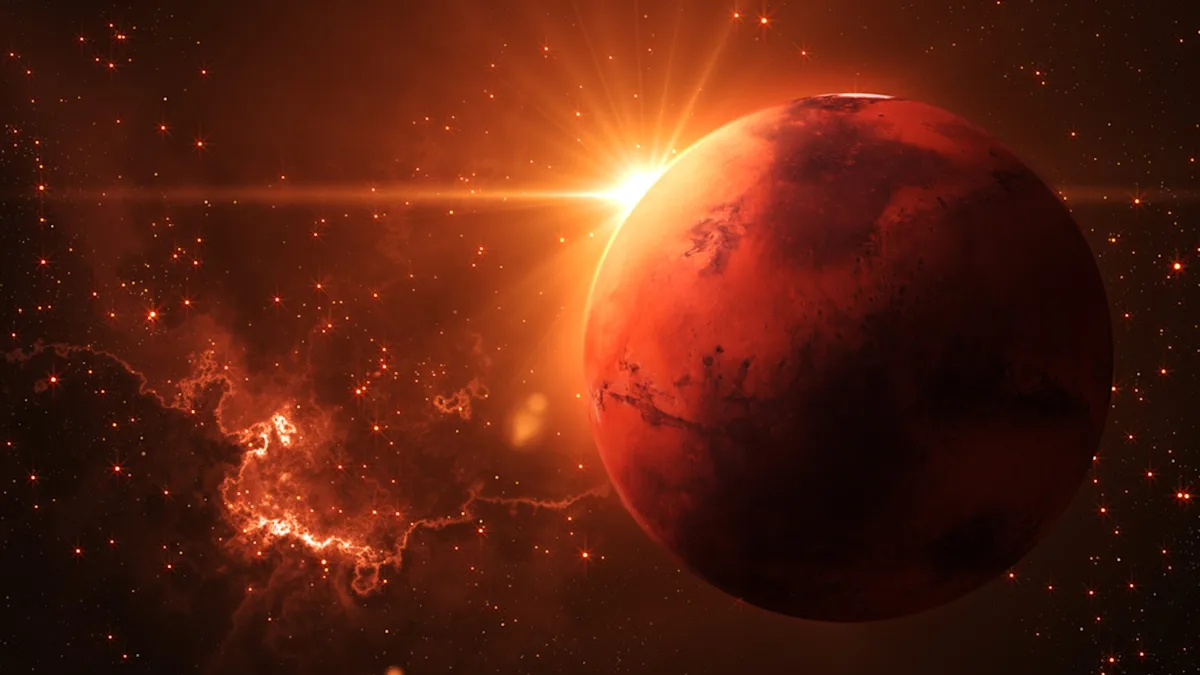
A powerful solar storm that struck Mars in December 2023 has helped scientists uncover previously hidden plasma structures in the planet’s ionosphere, offering one of the clearest views yet of how the Red Planet continues to lose its atmosphere to space.
The discovery, made using data from NASA’s MAVEN (Mars Atmosphere and Volatile EvolutioN) spacecraft, is giving researchers fresh insight into the long-term atmospheric erosion that transformed Mars from a potentially warmer, wetter world into the cold and dry planet seen today.
Scientists say the event created an unusually intense interaction between solar wind and the Martian atmosphere, exposing complex plasma behavior that had never been directly observed before.
Rare Solar Event Created a Natural Scientific Experiment
In December 2023, the Sun released a powerful burst of charged particles and magnetic energy toward Mars during a period of heightened solar activity. When the storm reached the planet, it triggered dramatic changes in the upper atmosphere and ionosphere.
Unlike Earth, Mars lacks a strong global magnetic field capable of shielding its atmosphere from incoming solar radiation. As a result, solar storms can directly impact the planet’s atmospheric layers, compressing them and stripping away charged particles into space.
Researchers described the event as a rare “natural laboratory” that allowed instruments aboard MAVEN to capture plasma structures usually too faint or unstable to detect under normal conditions.
According to NASA scientists, the storm temporarily intensified electric and magnetic interactions around Mars, revealing dense plasma formations and turbulent atmospheric behavior across the ionosphere.
MAVEN Spacecraft Captured Unprecedented Plasma Activity
NASA’s MAVEN spacecraft, which has been orbiting Mars since 2014, was specifically designed to study how the planet’s atmosphere interacts with the Sun and gradually escapes into space.
During the solar storm, MAVEN recorded sharp increases in ionized particles, magnetic field fluctuations, and atmospheric compression. Scientists observed unusual plasma waves and layered structures forming within the ionosphere — the electrically charged region of the atmosphere created by solar radiation.
Researchers noted that these plasma formations appeared more organized and dynamic than expected, suggesting that extreme solar events can temporarily reshape the Martian atmospheric environment.
The spacecraft’s instruments also detected accelerated atmospheric escape, where charged particles were carried away by solar wind at much higher rates than during calm solar conditions.
Why the Discovery Matters for Mars’ Climate History
One of the biggest mysteries surrounding Mars is how it lost most of its atmosphere over billions of years. Geological evidence suggests ancient Mars once had rivers, lakes, and possibly conditions suitable for microbial life.
Scientists believe continuous exposure to solar wind played a major role in stripping away atmospheric gases after Mars lost its magnetic field billions of years ago.
The latest MAVEN observations provide direct evidence of how intense solar activity can accelerate atmospheric loss processes. By studying these interactions in real time, researchers can improve models that estimate how rapidly Mars’ atmosphere disappeared over geological history.
Planetary scientists say the findings are important not only for understanding Mars but also for studying other planets without strong magnetic protection.
Solar Wind Compression Revealed Hidden Ionosphere Dynamics
The Martian ionosphere behaves differently from Earth’s because of the planet’s weak magnetic shielding and thinner atmosphere. During the December 2023 storm, solar wind pressure compressed the ionosphere to unusually low altitudes.
This compression exposed plasma boundaries and electromagnetic structures that are normally difficult to observe. Scientists believe these hidden regions play a critical role in regulating how atmospheric particles escape into space.
Researchers also identified turbulent plasma motion triggered by the storm, which may influence communication systems and spacecraft operations around Mars during future human and robotic missions.
The observations are expected to help engineers better prepare spacecraft for extreme space weather conditions beyond Earth.
Experts Say Findings Could Improve Future Mars Missions
Space weather has become an increasingly important area of research as agencies prepare for long-duration lunar and Martian missions. Understanding how solar storms interact with planetary atmospheres is critical for protecting astronauts, satellites, and onboard electronics.
Scientists involved in the MAVEN mission say the new data will improve predictive models of Martian atmospheric behavior during solar events. The research may also help future missions identify safer orbital conditions and better communication strategies during periods of intense solar activity.
The findings arrive as the Sun approaches the peak of its current solar cycle, a period expected to produce more frequent and powerful solar storms across the solar system.
Mars Continues to Reveal Clues About Planetary Evolution
More than a decade after entering orbit around Mars, MAVEN continues to reshape scientific understanding of the planet’s atmospheric evolution. The spacecraft has already confirmed that solar wind is a major driver of atmospheric loss, but the December 2023 storm provided one of the clearest demonstrations yet of the process in action.
Researchers say continued monitoring during future solar events could uncover even more hidden structures and atmospheric mechanisms that influence Mars today.
As solar activity intensifies over the coming years, scientists expect additional opportunities to study how extreme space weather transforms planetary environments across the solar system.