 TECH TIMES NEWS
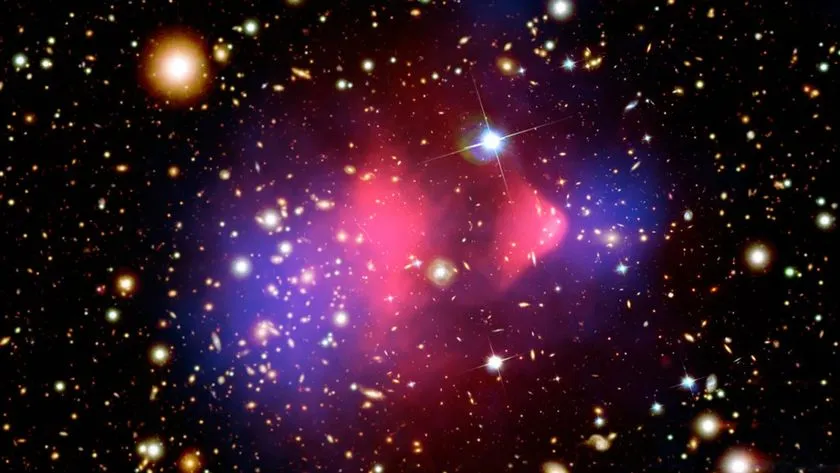
Dark matter, the invisible substance believed to make up nearly 85% of the universe’s total matter, may not be as silent as scientists once thought. New research suggests that dark matter could interact with neutrinos—often called “cosmic ghost particles” due to their ability to pass through ordinary matter almost undisturbed. If confirmed, this discovery could mark a major turning point in our understanding of the universe’s fundamental forces.
What Are Cosmic Ghost Particles?
Neutrinos are among the most abundant particles in the cosmos, streaming through planets, stars, and even human bodies every second without leaving a trace. Generated in massive numbers by stars, supernovae, and nuclear reactions, neutrinos rarely interact with anything, making them extraordinarily difficult to detect. Their elusive nature has long fascinated physicists searching for clues beyond the Standard Model of particle physics.
New Evidence from Advanced Detectors
The latest findings come from sophisticated underground and space-based detectors designed to capture rare particle interactions. Scientists observed subtle anomalies in neutrino behavior—small deviations that cannot be fully explained by known physics. These irregularities hint that neutrinos may be interacting with an unknown substance, potentially dark matter itself.
Why This Changes Everything
Until now, dark matter has only been observed through its gravitational influence on galaxies and cosmic structures. Evidence of direct interaction with neutrinos would offer the first non-gravitational link between dark matter and known particles. Such a breakthrough could help scientists narrow down what dark matter is actually made of and how it fits into the broader framework of physics.
Implications for the Universe’s Evolution
If dark matter and neutrinos do interact, the consequences could stretch from the smallest particles to the largest cosmic structures. This interaction may have influenced how galaxies formed, how energy moved through the early universe, and even how matter itself evolved after the Big Bang.
Cautious Optimism in the Scientific Community
Researchers stress that more data is needed before drawing firm conclusions. Upcoming experiments with higher sensitivity are expected to test these early signals. Still, many physicists view the findings as one of the most promising leads in decades in the hunt to uncover dark matter’s true nature.
The Road Ahead
As next-generation observatories come online, scientists hope to either confirm or rule out this mysterious interaction. If proven, it could open an entirely new chapter in particle physics, reshaping how humanity understands the invisible forces that govern the cosmos.