 TECH TIMES NEWS
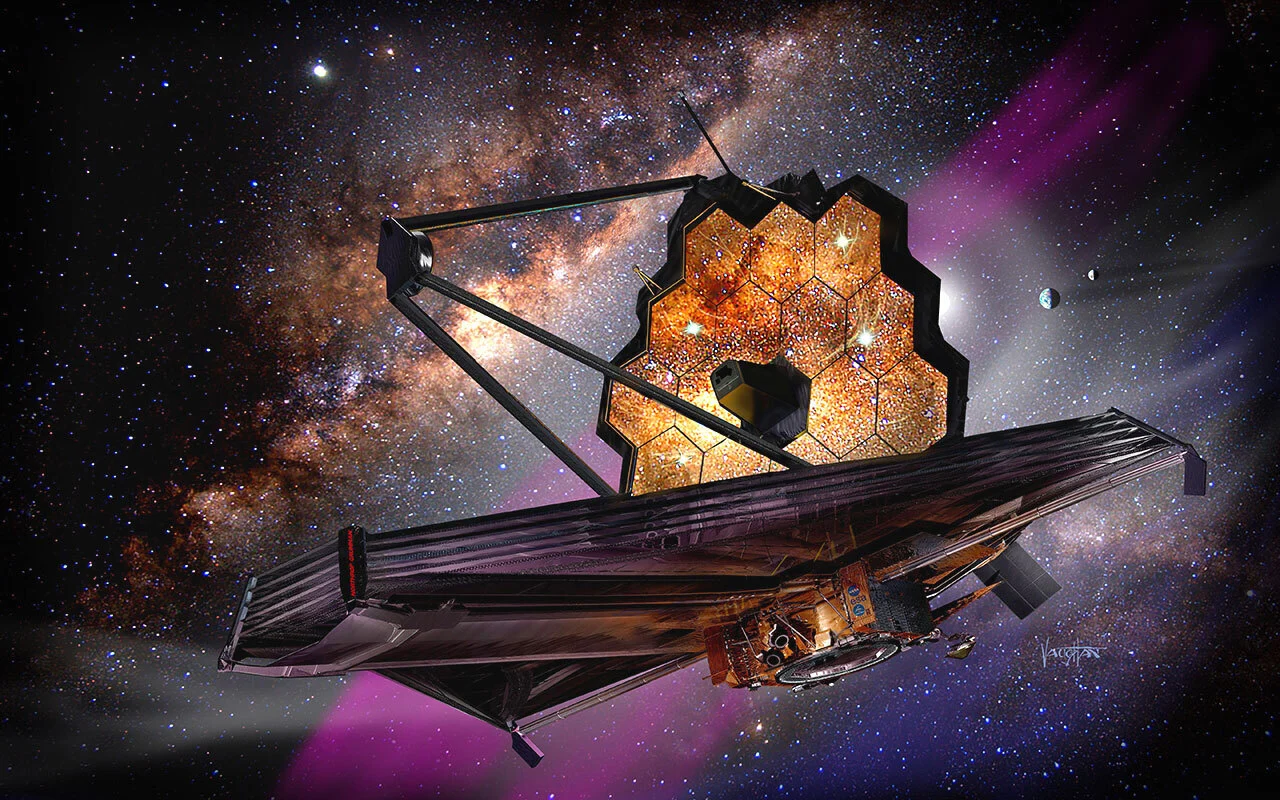
Dark matter remains one of the most puzzling components of the universe, accounting for nearly 85% of all matter yet remaining invisible to direct observation. Scientists have long relied on indirect evidence—such as galaxy rotation curves and gravitational lensing—to infer its presence. Now, astronomers believe the James Webb Space Telescope (JWST) could help reveal dark matter in ways that were not originally anticipated when the mission was designed.
Rather than detecting dark matter particles directly, Webb’s extraordinary sensitivity in infrared wavelengths is enabling researchers to study subtle cosmic effects that may point to how dark matter behaves and clusters across the universe.
Seeing the Invisible Through Gravitational Clues
One of JWST’s most promising contributions lies in its ability to observe gravitational lensing with unprecedented precision. When massive objects like galaxy clusters bend light from distant galaxies behind them, the distortions depend heavily on how mass—including dark matter—is distributed.
With its sharp resolution, Webb can map these distortions in fine detail, allowing astronomers to build more accurate dark matter distribution models. Small anomalies in lensing patterns could even hint at whether dark matter is “smooth” or made up of clumps, a key question in modern cosmology.
Early Galaxies May Hold Dark Matter Answers
JWST is also transforming our understanding of early galaxy formation. By observing galaxies that formed just a few hundred million years after the Big Bang, scientists can compare real-world data with simulations that assume different dark matter properties.
If early galaxies appear more massive, more compact, or more evolved than expected, it could suggest that dark matter behaves differently than current models predict—possibly interacting weakly with itself or decaying over cosmic time.
Unexpected Signals in Starlight and Heat
Another unanticipated avenue involves Webb’s ability to measure faint infrared emissions from stars and gas clouds. Some theoretical models suggest that dark matter interactions could subtly influence how stars form or how heat is distributed in dense galactic cores.
By tracking temperature variations, star formation rates, and chemical compositions with extreme accuracy, Webb may uncover indirect signatures of dark matter influencing visible matter—something earlier telescopes struggled to detect.
Challenging Existing Dark Matter Models
The data coming from JWST could put pressure on long-standing theories such as cold dark matter (CDM). If observations consistently diverge from CDM-based simulations, scientists may need to explore alternatives like warm dark matter or self-interacting dark matter.
This makes JWST not just a discovery tool, but a reality check for decades of theoretical work.
A Telescope Redefining Its Own Mission
While the James Webb Space Telescope was built primarily to study stars, galaxies, and exoplanets, its growing role in dark matter research highlights how transformative instruments often exceed their original goals.