 TECH TIMES NEWS
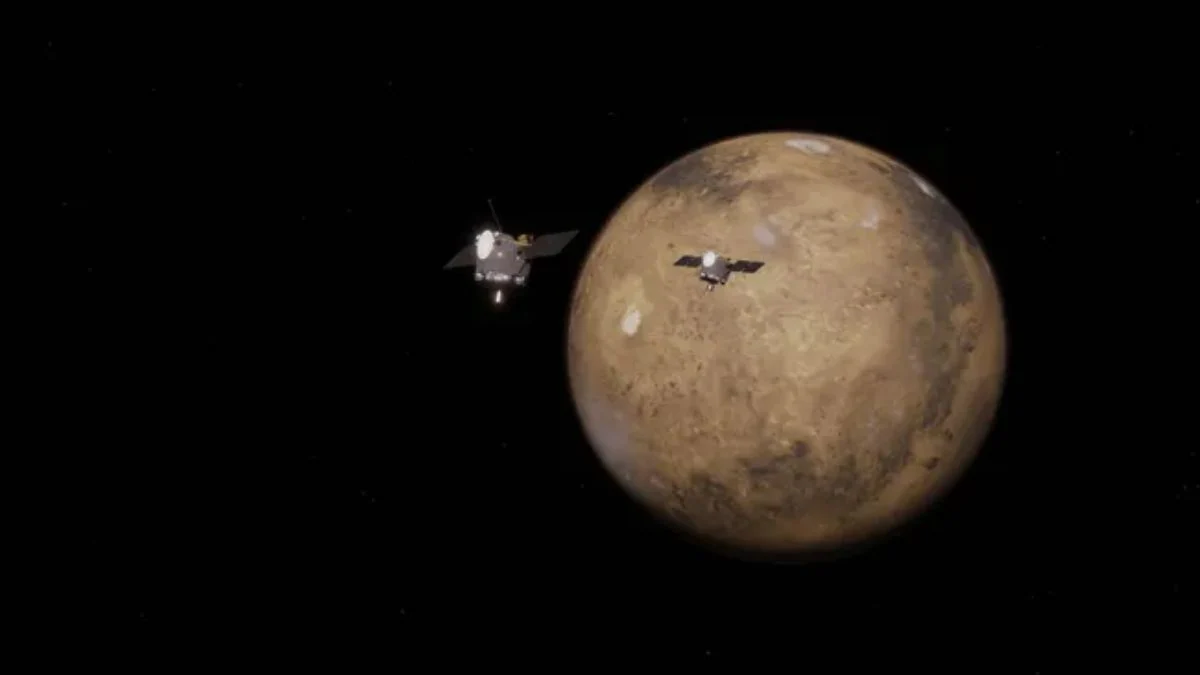
NASA is preparing to advance its understanding of space weather with the ESCAPADE mission — short for Escape and Plasma Acceleration and Dynamics Explorers. The mission is designed to investigate how solar activity travels across the vast distance between Earth and Mars, shaping the Martian atmosphere and influencing future human exploration plans.
Unlike traditional large-scale planetary missions, ESCAPADE will deploy two compact spacecraft that will operate in orbit around Mars. Their goal is to provide simultaneous measurements of plasma and magnetic fields, offering a clearer picture of how solar storms interact with the Red Planet.
Why Space Weather Between Earth and Mars Matters
Space weather refers to disturbances caused by the Sun, including solar flares and coronal mass ejections. These events release high-energy particles and magnetic fields that travel through space at tremendous speeds.
While Earth is protected by a strong magnetic field, Mars lacks a global magnetic shield. This makes its atmosphere far more vulnerable to erosion by solar winds. By studying how these solar particles move from Earth’s orbit toward Mars, scientists can better understand atmospheric loss on Mars and improve forecasting models for future astronauts traveling through deep space.
Twin Spacecraft for Better Measurements
The ESCAPADE mission will consist of two small satellites that will orbit Mars at slightly different altitudes. This configuration allows researchers to collect simultaneous readings from multiple vantage points — a critical advantage when studying dynamic solar events.
These spacecraft will measure plasma density, magnetic fields, and energy transfer processes in the Martian magnetosphere. By comparing data from both orbiters, scientists can determine how solar storms evolve as they move across interplanetary space.
Supporting Future Human Missions to Mars
One of the most important aspects of ESCAPADE is its contribution to human exploration. As space agencies prepare for crewed missions to Mars in the coming decades, understanding radiation exposure risks is essential.
Solar storms can pose significant hazards to astronauts traveling beyond Earth’s protective magnetosphere. Data from ESCAPADE will help refine predictive models, allowing mission planners to design safer spacecraft shielding and develop more accurate warning systems.
Part of NASA’s Cost-Effective Exploration Strategy
ESCAPADE is part of NASA’s broader effort to use smaller, more affordable spacecraft to conduct focused scientific investigations. By leveraging compact satellite technology, the mission demonstrates how high-impact science can be achieved without the cost of large flagship programs.
The mission also complements ongoing Mars exploration efforts, adding a new layer of heliophysics research to planetary science.
Bridging the Knowledge Gap in Deep Space
Despite decades of studying the Sun and Mars separately, the region between Earth and Mars remains comparatively underexplored. ESCAPADE aims to close this gap by tracking how solar energy and charged particles propagate across millions of kilometers.
The findings could reshape our understanding of planetary atmosphere evolution — not only for Mars but for other planets lacking strong magnetic protection.
Looking Ahead
As launch preparations move forward, scientists anticipate that ESCAPADE will deliver critical insights into the Sun’s influence on the solar system. By mapping space weather conditions along the Earth-Mars corridor, the mission could play a pivotal role in making long-duration human space travel safer and more sustainable.
With ESCAPADE, NASA continues to push the boundaries of heliophysics research while laying the groundwork for humanity’s next giant leap toward Mars.