 TECH TIMES NEWS
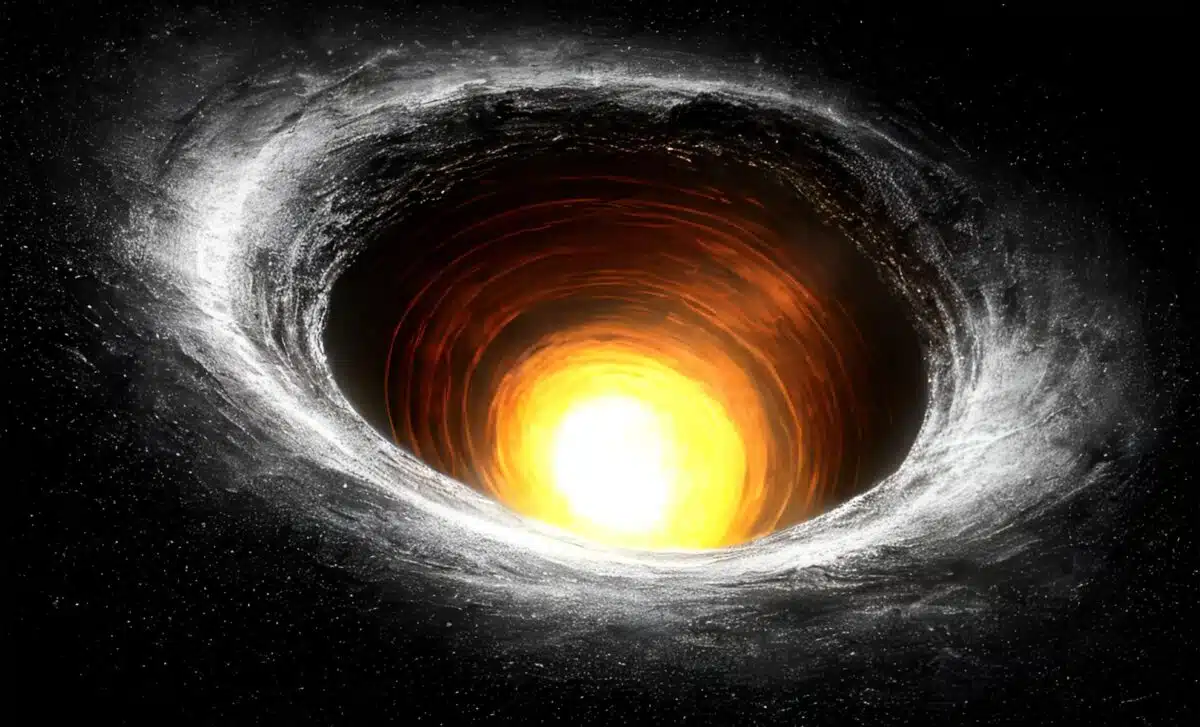
Astronomers have identified a mysterious “dark object” located nearly 11 billion light-years from Earth, detected not by emitted light, but through its powerful gravitational influence on surrounding space. The discovery sheds new light on hidden structures in the early universe and could reshape scientists’ understanding of cosmic evolution.
A Discovery Made Without Seeing Light
Unlike stars or galaxies that are observed through visible or infrared light, this object revealed itself solely through gravitational lensing — a phenomenon where massive bodies bend and distort light from background sources. Researchers noticed subtle but consistent distortions in the light of distant galaxies, indicating the presence of a massive object that does not emit detectable radiation.
What Could the Dark Object Be?
Scientists suggest the object could be an ancient supermassive black hole, a dense clump of dark matter, or even an exotic form of compact mass formed during the universe’s early stages. Its immense gravity implies it is extraordinarily massive, yet its lack of emitted light makes classification challenging.
Peering Into the Early Universe
At a distance of 11 billion light-years, the object is being observed as it existed when the universe was less than three billion years old. This provides rare insight into how massive structures formed so quickly after the Big Bang, a question that has long puzzled astronomers.
Advanced Instruments Made the Detection Possible
The detection was made using a combination of space-based telescopes and ground observatories, capable of measuring minute gravitational distortions across vast cosmic distances. Improved data analysis techniques allowed astronomers to isolate the signal from background noise, confirming the object’s presence.
Why This Discovery Matters
Finding massive objects that remain invisible challenges traditional observation methods and suggests that the universe may contain far more hidden structures than previously estimated. Such discoveries could help refine models of dark matter distribution, black hole formation, and large-scale cosmic architecture.
What Comes Next
Astronomers plan follow-up observations using next-generation telescopes to better constrain the object’s mass and nature. While it remains unseen, its gravitational signature continues to offer valuable clues about the unseen forces shaping the universe.